

Achtung! Your Job Might Be in the Hidden AI Risk Zone
The AI disruption everyone’s talking about? You’re probably looking in the wrong place. New research from MIT shows the real impact won’t hit tech jobs first—it’s already reshaping the office and administrative work that exists in nearly every organization. This article reveals where AI’s hidden risk zone really is.
Umair Ali Khan & Martti Asikainen, 14.12.2025 | Photo by Adobe Stock Photos
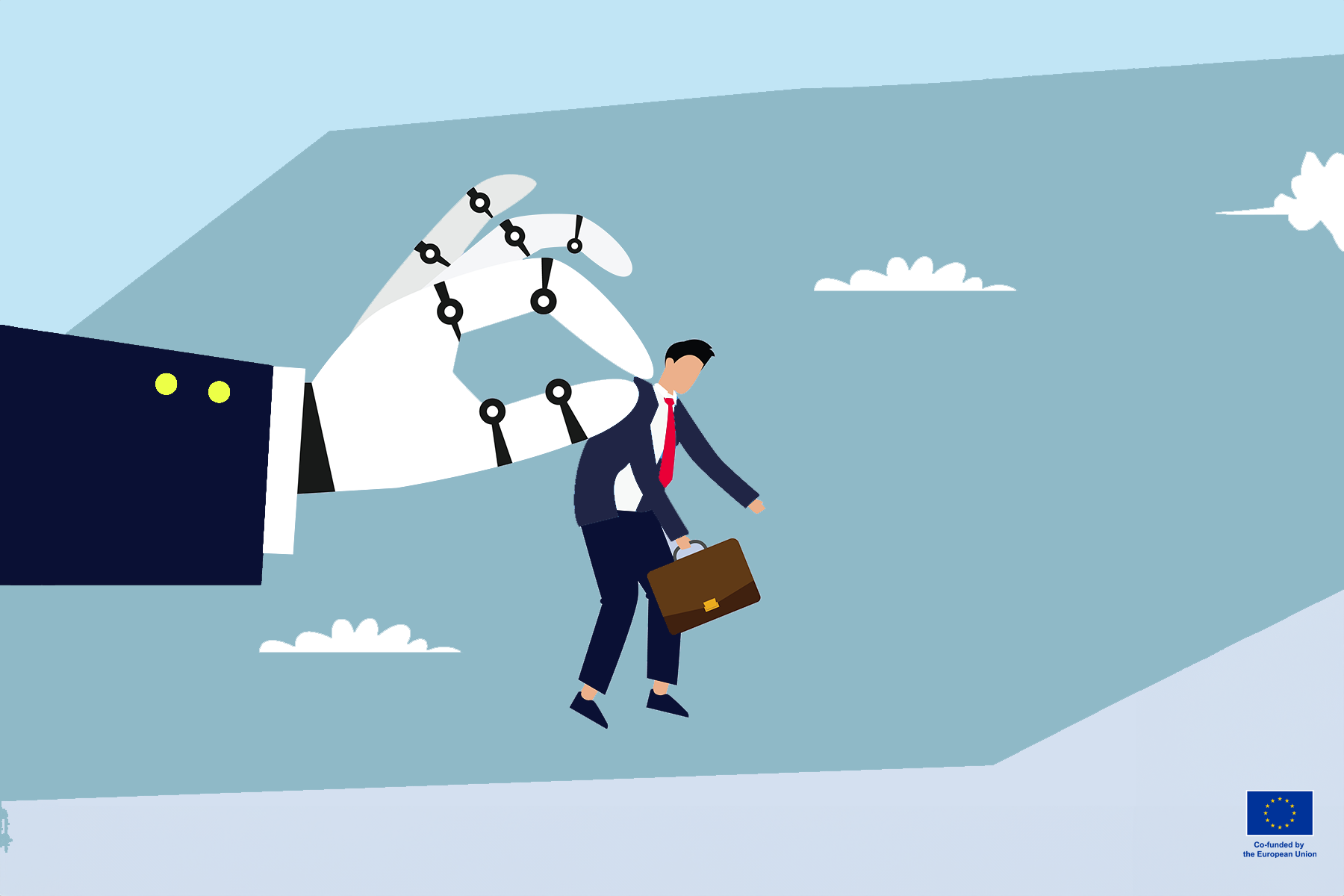
AI is not coming only for tech jobs. Back-office workers may face AI disruption before software engineers do. That’s one surprising finding from MIT’s latest study on AI workplace adoption, and it contradicts much of the conversation around which jobs are considered safe.
While programmers and data scientists dominate headlines about AI replacement, the research reveals AI’s biggest near-term impact is in administrative workflows across industries: claims processing, compliance documentation, financial reconciliation, HR onboarding.
If you work in operations, finance, legal, or HR, or manage teams that do, here’s what the data actually shows about where AI adoption is happening fastest and why.
The Pattern of Disruption We've Seen Before
This fear isn’t new. Every major technology shift triggers the same anxiety — and the same pattern. In the 1990s, typists and ledger keepers were terrified, when saw computers coming.
People were sure that computers would wipe out their jobs. In the end, many retrained as administrative assistants and spreadsheet analysts. Others didn’t, and those roles largely vanished. But it wasn’t the technology alone that decided who stayed employed. It was who adapted to it. The people who learnt to work with the new tools kept their place in the labour market and are still here.
Today’s headlines echo the same surprise: AI already overlaps with a significant share of everyday knowledge work, yet most of that exposure remains hidden from view (Dastin & Shalal 2025; Snelling 2025). The pattern repeats because the biggest risk isn’t always visible. Risk of not seeing the change at all.
Travel agents didn’t think online booking was a threat until Expedia had already captured the market. Photo lab technicians never imagined their entire industry would disappear within a decade, because of the digital cameras and photos. Bank tellers assumed branch work would always require a human touch — until ATMs and mobile apps proved otherwise.
What made these workers vulnerable wasn’t just technology. It was invisibility. Their jobs sat in a “hidden risk zone”, roles that seemed stable right up until they weren’t. They had no warning because no one was watching their sector closely enough. People tend to close their eyes in such situations.
The Iceberg Index: Measuring Hidden Exposure
This is precisely the kind of blind spot that recent task-based AI research aims to uncover. A new study from MIT’s Project Iceberg suggests that AI’s impact on jobs is much bigger and more complex than it looks on the surface. The researchers introduce an “Iceberg Index” — a skills-centered metric that estimates how much of the wage value in each occupation could, in principle, be done by AI systems (Chopra et al. 2025).
This Index measures technical exposure: where AI can actually perform tasks inside a job. One of the most striking findings is that the visible AI adoption we see today, mostly in computing and tech roles, is just the tip of the iceberg. The much larger “hidden zone” sits in administrative, financial, and professional services, where a lot of work is digital, repetitive, and information-heavy.
This concentration of exposure in office and administrative work is consistent with broader research trends: a bibliometric analysis of AI and employment research shows that office and administrative support occupations are among the most frequently studied in relation to AI-driven transformation (Pennathur et al. 2024).
In our own work with companies in the Finnish AI Region (FAIR), this rings true. We’ve seen it with our very own eyes. The first meaningful AI wins are almost never about full automation or robots. They’re about invoices and purchase orders, sales proposals, contracts, emails, customer documents, and routine reports. The quiet backbone of day-to-day operations. Below, we’ll break down the key findings from the MIT study in plain language and focus on what they mean for understanding where AI will hit hardest.
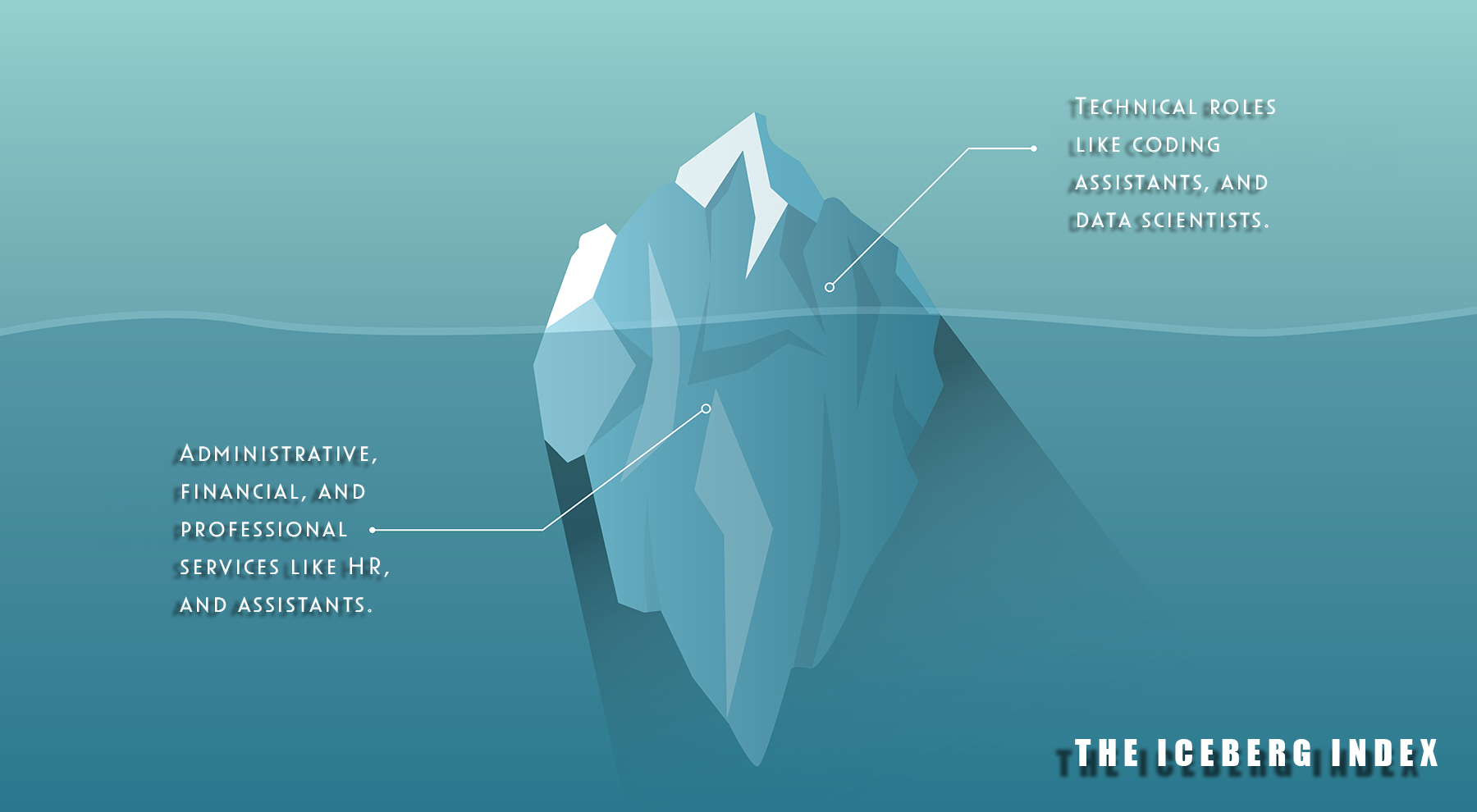
The Iceberg Index reveals that technical jobs are just the tip of the iceberg. The greater threat lies beneath: administrative and professional services roles.
The Visible AI Disruption is Surprisingly Small
When we talk about AI and jobs, we usually picture software developers using AI coding assistants, data scientists, and technical roles in big tech companies. This is the “surface” of the iceberg: the part we can already see.
AI does have significant overlap with tasks in these tech roles. But here’s the key point: tech jobs represent only a thin slice of the total economy. When you look at the entire labor market, this visible surface accounts for just a few percent of total wage value.
Most people don’t work in software or data science. They work in administration, healthcare, education, logistics, manufacturing, retail, and public services. So even though AI overlaps strongly with tech tasks, that overlap touches only a small fraction of all the work people are paid to do.
As a key insight, the surface disruption we see in today’s headlines is real, but it’s concentrated in a narrow group of occupations and represents only a small fraction of the total potential exposure. The larger story lies beneath.
The Hidden Mass: Office, Admin, and Professional Work
The big insight comes when you look beyond obvious tech jobs and include administrative, financial, and professional service roles. These include back-office operations, document processing, routine analysis, HR and coordination work, reporting, and compliance tasks (Chopra et al. 2025).
When the Iceberg Index includes these roles, the picture shifts dramatically. As industry analysis notes, the “real mass of capability” lies far below the surface in these cognitive, information-heavy tasks (Sellers 2025). Suddenly, when these kinds of roles are added to the picture, and we include everyday office work, the potential AI impact becomes much larger than what we see in tech alone.
The largest block of AI exposure is not in coding. It’s in routine, repeatable office tasks that exist in almost every organization, regardless of sector. This matches what we’ve see in practice. In our AI consultancy work with small and medium-sized enterprises (SME), the first useful AI pilots rarely start with let’s replace our developers.
No, instead they usually start with:
- Processing invoices, purchase orders, and customer documents
- Searching internal knowledge and documents
- Creating and updating customers’ query tickets
- Resolving customer complaints
- Generating routine reports and quotations
- Extracting key information from a pile of documents
As a key insight, AI’s biggest near-term impact will likely land in white-collar, cognitive work. The everyday office tasks that quietly hold organizations together, not just high-profile tech jobs (Snelling 2025).
The Automation Surprise
Some regions and sectors don’t consider themselves “high tech” at all—yet they’re highly exposed to AI once you look at their office and professional work. Think about places where:
- Factories and warehouses rely on large administrative back offices
- Banks and insurance companies handle huge volumes of documents and routine analysis
- Service organisations depend on constant coordination, scheduling, and reporting
These areas might be investing heavily in robots, sensors, and “Industry 4.0” on the production side—while quietly overlooking how vulnerable their office roles are. Planners, coordinators, analysts, HR, finance, and customer support staff spend most of their time on screen-based, repetitive tasks.
The surprise comes when organizations realize that AI can transform the office work around the production line faster than the production line itself. Automating scheduling, reporting, approvals, documentation, and customer interactions moves much more quickly than installing robots on the shop floor.
In case you’re wondering about the key insight, in many places, the biggest shock from AI may not come from machines replacing physical labour, but from AI rapidly reshaping the office work that surrounds it.
Why a Country's GDP and Unemployment Don't Show Where AI Will Hit
When we talk about the health of an economy, we usually look at three numbers: GDP, unemployment, and average income. These are useful metrics, but they don’t tell us much about how AI will affect work.
Consider two different regions:
- Region A has strong GDP, low unemployment, and high incomes. On paper, everything looks great. But a large share of its jobs involve digital, repetitive, information-heavy tasks in offices and professional services. That makes it highly exposed to AI—even if nobody sees it yet.
- Region B is struggling economically, but its jobs rely more on tasks that are harder to automate in the short term: face-to-face care, complex manual work, or highly context-specific activities. Its immediate AI exposure may actually be lower.
The difference comes from what people actually do all day, not from headline economic numbers. AI looks for:
- Routine processing of information
- Digital documents and data
- Structured, repeatable workflows
Those patterns are hidden inside job descriptions and task lists, not in GDP charts. The key insight: GDP, unemployment, and income show how the economy is doing today, but they don’t reveal which tasks and skills are most exposed to AI. To plan sensibly, leaders need to look beyond headline indicators and understand the actual work being done.
This distinction also helps explain why large AI exposure doesn’t automatically translate into immediate mass unemployment. A recent systematic review of generative AI and employment effects finds that, in the near term, AI most often reshapes tasks within jobs rather than eliminating entire occupations, especially in information-heavy white-collar work (Salari et al. 2025).
This leads to another insight: jobs that rely heavily on complex manual work are unlikely to be replaced by AI any time soon. Electricians, plumbers, carpenters, mechanics, construction workers, and similar trades may change over time, but they’re not first in line for AI-driven disruption.
What This Means for You
Understanding where AI’s impact will really land is the first step. The pattern is clear:
- The visible disruption in tech jobs is real but small. It affects only a few per cent of the total workforce
- The hidden mass lies in office and administrative work. This is where AI can tackle routine, digital, information-heavy tasks at scale
- Non-tech sectors face unexpected exposure. Industrial and service organisations may see their back offices transformed before their production lines
- Traditional economic indicators don’t reveal AI risk. You need to look at what people actually do, not just GDP or unemployment rates
- Manual trades remain relatively protected. Complex physical work is harder to automate than cognitive office tasks
In our next article, we’ll explore how organisations and policymakers can turn this understanding into concrete action plans. We’ll show you the questions to ask, the strategies to consider, and how to prepare your workforce before the disruption arrives. Make sure you’ll stay tuned.
References
Chopra, A., Bhattacharya, S., Salvador, D., Paul, A., Wright, T., Garg, A., Ahmad, F., Schwarze, A. C., & Balaprakash, P. (2025). The Iceberg Index: Measuring workforce exposure across the AI economy (arXiv:2510.25137). arXiv. https://doi.org/10.48550/arXiv.2510.25137
Dastin, J. & Shalal, A. (2025, December 4). AI’s rise stirs excitement, sparks job worries. Reuters. Retrieved December 10, 2025, from https://www.reuters.com/business/media-telecom/ais-rise-stirs-excitement-sparks-job-worries-2025-12-04/
MIT Project Iceberg. (2025). Project Iceberg – Coordinating the human–AI future. University research initiative. Retrieved December 10, 2025, from https://iceberg.mit.edu/
Pennathur, P. R., Boksa, V., Pennathur, A., Kusiak, A., & Livingston, B. (2024). The future of office and administrative support occupations in the era of artificial intelligence: A bibliometric analysis. arXiv. https://doi.org/10.48550/arXiv.2405.03808
Salari, N., Beiromvand, M., Hosseinian-Far, A., Habibi, J., Babajani, F., & Mohammadi, M. (2025). Impacts of generative artificial intelligence on the future of labor market: A systematic review. Computers in Human Behavior Reports, 18, 100652. https://doi.org/10.1016/j.chbr.2025.100652
Sellers, M. (2025 December 3). AI can already do nearly 12% of your work. Insurance Business Magazine. Retrieved December 10, 2025, from https://www.insurancebusinessmag.com/us/news/technology/ai-can-already-do-nearly-12-of-your-work-558811.aspx
Snelling, G. (2025, November 26). MIT study finds AI is already capable of replacing 11.7% of U.S. workers. Fast Company. Retrieved December 10, 2025, from https://www.fastcompany.com/91450119/mit-study-finds-ai-is-already-capable-of-replacing-11-7-of-u-s-workers

Dr. Umair Ali Khan
Senior Researcher
Finnish AI Region
+358 294471413
umairali.khan@haaga-helia.fi

Martti Asikainen
Communications Lead
Finnish AI Region
+358 44 920 7374
martti.asikainen@haaga-helia.fi


Finnish AI Region
2022-2025.
Media contacts