

How (Not) to Destroy Your Business with AI
Every week, another company announces its bold AI transformation. A few months later, that same company has a pilot project gathering dust, a confused team, and an executive quietly wondering where the budget went. The pattern is predictable. The pain is avoidable. AI can unlock genuine business value — but only if you stop making the same strategic mistakes everyone else is making.
Umair Ali Khan & Martti Asikainen 5.2.2026 | Photo by Adobe Stock Photo

AI can unlock real business value. But only if it is implemented wisely. Because a lot of companies walk into AI expecting magic and walk out with an expensive pilot no one uses, a confused team, and a brand-new set of problems they didn’t have before.
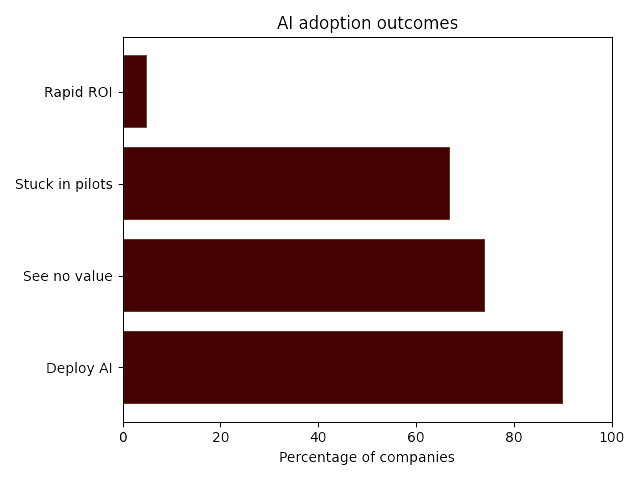
Nearly 90% of companies now deploy AI in some form, yet almost two-thirds are still stuck in experimental pilots instead of reaching scaled impact (Singla et al., 2025). Another study found that three-quarters of companies have yet to see tangible value from their AI efforts (Boston Consulting Group, 2024).
According to a recent MIT report, only 5% of enterprise AI projects deliver rapid revenue gains, and the rest stall with little to no ROI (Estrada, 2025).
Those numbers are not a sign that AI doesn’t work. They are a sign that businesses often make avoidable, strategic mistakes. In this article, we will walk through the most common ways companies sabotage their AI initiatives, and what to do instead, so AI strengthens your business value rather than quietly setting it on fire.
1. No Clear Strategy or Business Goal
One of the fastest ways to derail an AI project is to adopt it because everyone else is. It is the corporate version of buying a treadmill because your neighbor did, except the treadmill costs six figures, needs clean data, and comes with a privacy review.
A recent survey of tech CEOs found that roughly 25–27% of businesses start implementing AI with no defined goals or strategy, essentially chasing hype rather than solving a real problem (Paladiy, 2025). And when AI is deployed for the sake of the trend, the outcome is painfully predictable:
- A pilot project that goes nowhere.
- A budget that quietly evaporates.
- And a team that starts rolling their eyes every time someone says “AI transformation.”
AI is not a silver bullet. It only creates value when it is tightly aligned to a concrete business objective. Without that alignment, you’re not innovating — you’re just renting expensive software that no one knows how to use.
What should you do instead
Start with strategy, not software. Before you buy tools or hire consultants, get specific about the business problem you are trying to solve. Look for pain points or opportunities where AI could genuinely move the needle, for instance, things like reducing manual processing time, improving customer satisfaction, offering services that cannot be offered without AI, and so on.
Then define what winning looks like before you build anything. That means picking measurable success criteria, including KPIs, cost savings targets, revenue goals, time-to-resolution reductions, and whatever matters in your business. In other words, treat AI as a means to a business end, not the end itself. Companies that integrate AI into their core strategy, rather than bolting it on as a trendy add-on, are far more likely to see meaningful impact.
2. Expecting ROI Without Pilot-to-Production Planning
A lot of AI projects don’t fail. They just never finish. They end up in a promising proof-of-concept, a few nice slides, a demo that works great in a controlled setting, and then nothing. No rollout. No workflow integration.
The painful part? The AI itself is often fine. The execution is what breaks.
Companies build a cool demo, but they don’t have a roadmap to turn it into a real product. So, the pilot lives forever in a folder labelled ‘Phase 2,’ while the team moves on to the next shiny initiative.
The Hidden Culprit: Unrealistic Expectations
Some companies expect AI to generate ROI the way a new software license does: buy it, deploy it, watch the numbers go up. But capturing value from AI usually demands more than the model.
It requires process redesign, training, iteration, monitoring, and change management. Sometimes it requires decisions about who owns the system, who maintains it, and what happens when the AI model starts drifting six months later. And plenty of organizations admit they are not set up for that.
One study found 42% of companies cite an inadequate business case or financial justification as a top barrier to AI adoption (IBM Institute for Business Value, 2025). Reason? Many teams start building before they can clearly explain how the project would pay off.
What should you do instead
You should treat the pilot as a phase, not a static parking spot.
For every AI project, insist on a business case that is specific and measurable. Spell out the value in quantifiable terms, such as cost savings, increasing revenue, and efficiency gains. If you can’t describe the economic upside (or the strategic downside of doing nothing), you are not ready to build.
Then do the thing most teams skip. Plan for production before the pilot ends. Start small, yes, but plan for success. If the pilot hits its metrics, you should already know:
- who will own it in production
- what workflows it will plug into
- what systems it needs to integrate with
- what budget and staffing are required to scale it
- how will you monitor performance over time
High-performing AI adopters set clear value targets and focus on scaling what works, rather than accumulating a lab full of perpetual experiments.
3. Neglecting Data Quality and Preparation
AI runs on data. And the old rule still has not been replaced by anything smarter, i.e., garbage in, garbage out.
One of the quickest ways to cripple an AI initiative is to ignore the less glamorous work that happens before any model is trained: collecting, cleaning, structuring, and aligning the data so it can be trusted.
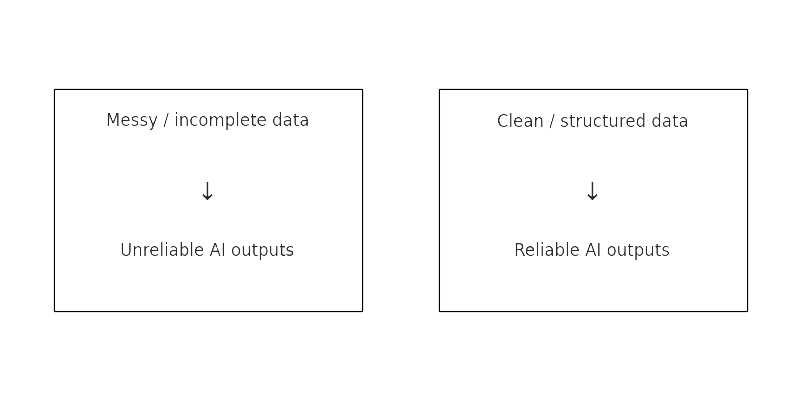
If you feed an AI system messy, incomplete, or low-quality data, you will get unreliable results and flawed recommendations that can actively mislead the business. The model might sound confident, but confidence is not the same thing as accuracy.
And a confident mistake scales beautifully. Many companies still underestimate how much effort data preparation takes. One survey reveals that poor data preparation is a major pitfall in AI projects (Paladiy, 2025). Realistically, it probably contributes to many more failures than people want to confess.
What should you do instead
Treat data as a first-class priority, not a supporting character. This means recognizing that data infrastructure and quality aren’t just technical concerns — they’re strategic decisions that determine whether your AI initiatives succeed or fail. Before you invest heavily in model building, invest in the foundations:
- data integration pipelines that bring sources together
- governance around who owns which datasets and who can change them
- quality checks that catch missing values, errors, and inconsistencies early
Run a rigorous data audit upfront. Identify gaps. Fix the basics. Make sure that the data you use is accurate, comprehensive, and actually relevant to the problem you are trying to solve. Because until you trust the inputs, you can’t trust the outputs. That’s how simple it is.
4. Skimping on Skills, Training, and Change Management
AI adoption is not just a technology project. It is a people project wearing a technology costume. Ignoring the human side is one of the most reliable ways to kill an AI initiative.
Organizational buy-in, talent, and training tend to be the biggest hurdles, often outweighing technical issues. In one 2025 study of tech leaders, 51% cited gaining organizational buy-in and training as the top challenge in implementing AI, nearly twice the rate of those pointing to any technical blocker (Mendes, 2025). This is why companies get surprised when nothing changes after pouring effort into tools and models.
Employees often don’t trust the AI, don’t understand it, or don’t see how it fits into their work. Workflows stay the same. The AI becomes a side dashboard that no one checks. The project stalls. Not because the AI was bad. Because the adoption was.
What should you do instead

If you want AI to create value, you have to build capability, not just software. That starts with upskilling. Training programs. Workshops. Practical sessions where people learn how to interpret AI outputs, when to question them, and how to use them responsibly.
But training alone is not enough. But training alone isn’t enough. You also need change management that is honest and proactive, the kind that addresses concerns head-on:
- explain how AI will augment work
- address fears directly, especially around job security
- involve stakeholders early so adoption is not something done to teams
- clarify new roles and responsibilities (who owns decisions, who escalates issues).
It also helps to create internal momentum. Many organizations establish a center of excellence, including people who can translate between technical teams and business users, share best practices, and support adoption as teams learn. But this only works if it has real authority and resources, not just a nice-sounding title.
5. Blindly Trusting AI Outputs Without Oversight
There are two ways to get AI wrong. One is ignoring it completely. The other is handing it the keys and walking away. Some companies go to the extreme of over-relying on AI without meaningful oversight.
Depending too heavily on AI can create dangerous blind spots, where decisions get made without human judgment or context, purely because the model said so. And models do get things wrong.
AI models can hallucinate incorrect answers, reflect biases embedded in training data, and fail silently when the real-world context changes. If no one is actively reviewing outputs, those errors don’t just slip through; they can compound.
What should you do instead
Use AI with a human-in-the-loop mindset. Treat AI-generated insights as decision support for recommendations, not autonomous verdicts. For high-stakes decisions, require human review and approval. And just as importantly, build a culture where people are expected to question outputs, not rubber-stamp them.
In practice, that means setting guardrails:
- clear rules for when to override AI (e.g., conflicts with domain knowledge, ethical standards, or policy)
- escalation paths when the model behaves strangely
- training teams in basic AI literacy so they understand strengths, weaknesses, and failure modes
- workflows that keep ultimate accountability with humans, not algorithms
6. Ignoring Governance, Ethics, and Risk Management
If there is one mistake that can truly destroy a business with AI, it is this one. Rushing ahead without governance.
Because, unlike a stalled pilot or a messy dataset, governance failures don’t just waste money; they can trigger legal penalties, security breaches, and a loss of customer trust that is incredibly hard to win back. And right now, plenty of companies are moving faster than their own guardrails.
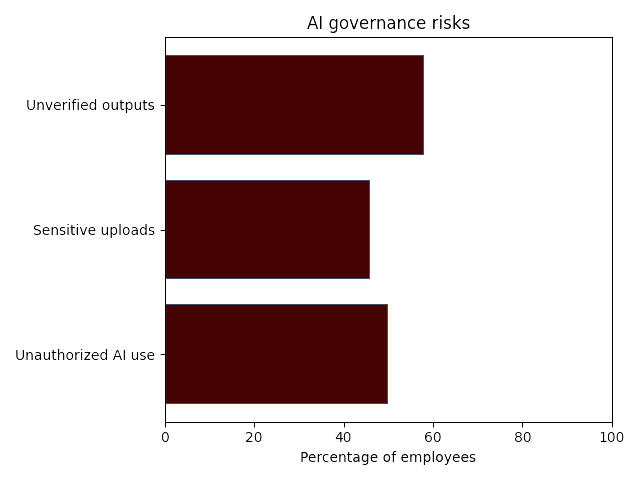
The KPMG survey (KPMG, 2025) found something unsettling. Half of employees are using AI tools at work without clear authorization from their employer. Even worse, 44% knowingly use AI in ways that violate company policy, including 46% who admitted uploading sensitive company data to public AI platforms.
That’s not a rogue employee problem. That’s a systems problem. It is what happens when leadership doesn’t provide clear guidelines and safe workflows. So employees fill the gap themselves. Shadow AI shows up, and data starts leaking into places it should not.
The same study also found that 58% of workers rely on AI to complete work without properly evaluating the outcomes, and over half hide their use of AI (KPMG, 2025). The combination of unauthorized tools, sensitive data exposure, and unverified outputs is not just messy. It is a ticking time bomb.
What should you do instead
Every business integrating AI needs a real governance framework, not a vague PDF that no one reads. Real governance means your policies actually shape behavior. It means employees know the rules, management enforces them, and the systems you build reflect them by design.
A governance framework that exists only in a document drawer isn’t governance — it’s liability waiting to happen. You need practical mechanisms that make doing the right thing the easy thing, and doing the wrong thing difficult or impossible. That includes things like:
- clear guidelines on acceptable AI use
- employee training on what is allowed (and why)
- technical enforcement where possible (like blocking uploads of confidential data to AI tools)
- transparent processes for approving new AI tools and use cases
It also means conducting ethical and risk reviews of AI systems:
- testing for bias and fairness
- ensuring explainability where decisions affect people’s lives or rights
- monitoring outputs over time
- documenting how the system works, what data it uses, and where it can fail
Many leading companies now use AI ethics committees or dedicated risk teams to oversee these issues. They also prepare for regulations, such as the EU AI Act and sector-specific rules, so their deployments don’t end up on the wrong side of the law.
If you ignore governance and ethics, you risk real damage to your business and brand. But if you build trustworthy AI, you don’t just avoid disaster, you earn something rarer than a quick win: trust.
7. Spreading AI Efforts Too Thin
One of the quieter ways companies sabotage AI is by trying to do everything at once.
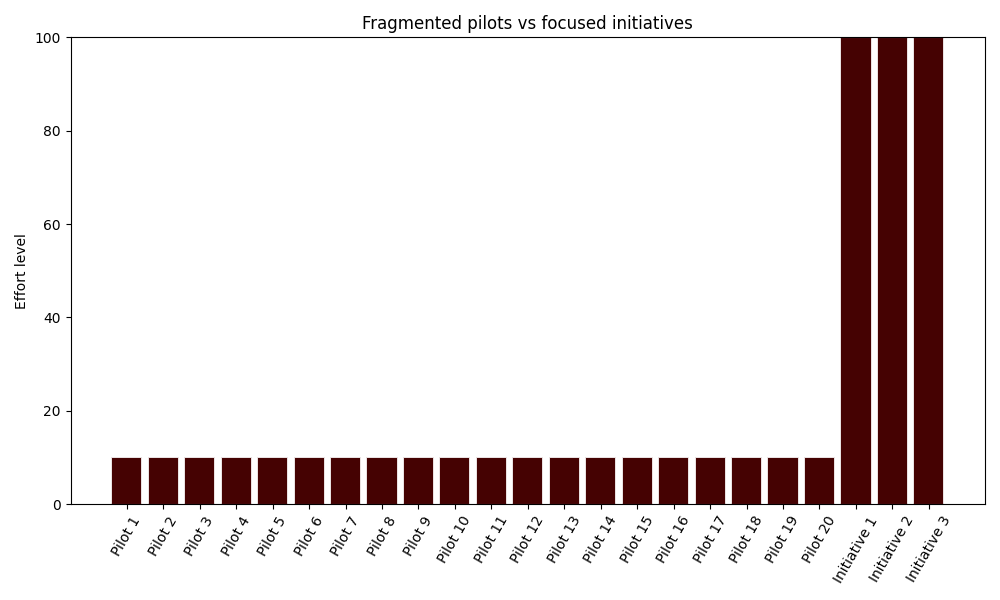
When the hype train is loud enough, it is easy to end up with dozens of experiments across every department: a chatbot here, a prediction model there, a smart dashboard somewhere else, and a growing graveyard of pilots no one remembers starting.
It looks like momentum. But it often produces the opposite.
Resources get diluted. Teams get distracted. And instead of a meaningful transformation, you get a handful of novelty demos and a lot of meetings titled “AI sync.”
What should you do instead
For established businesses, the lesson is simple: pick your battles. Don’t just adopt the trendiest AI use cases. Identify where AI can genuinely differentiate your company or materially improve core operations. That might be optimizing a supply chain workflow, improving customer personalization, or automating a painful manual process.
When you zero in on a handful of high-impact initiatives, you can concentrate talent and investment, and do them properly. Good data. Real integration. Training. Governance. Everything we have already talked about.
And you avoid spreading yourself thin across 20 pilots that never get the attention required to become production-grade.
So if you are serious about impact, prioritize initiatives that touch the core, i.e., the parts of your business that actually move the needle.
Don’t Let AI Become an Expensive Mistake
Integrating AI into your business is a journey full of potential pitfalls. But the good news is, you don’t have to discover them the hard way.
If there is one theme running through every AI failure story, it’s this: most projects don’t collapse because the algorithms are weak. They stall because humans make predictable mistakes. No strategy, no adoption plan, poor data hygiene, weak governance, or a total lack of focus.
So don’t let shiny AI tech blind you to basic business sense. Start with a clear goal and a realistic ROI plan. Get your data ready before you ask the model to perform miracles.
Invest in people, skills, training, and change management, so AI actually gets used instead of politely ignored.
Keep humans in the loop, especially when decisions are high-stakes. Build governance and ethical guardrails early, not after something goes wrong. And focus on the few use cases that matter most, instead of spreading effort across a dozen pilots that never reach production.
References
- Agile Brand Guide. (2025, December 2). “Because everyone else does”: Survey by Coupler.io reveals key mistakes businesses make in AI adoption. The Agile Brand Guide – News. Retrieved from https://agilebrandguide.com (summary of Coupler.io survey findings)
- Boston Consulting Group (BCG). (2024, October 24). AI Adoption in 2024: 74% of companies struggle to achieve and scale value [Press release]. BCG Press Room. Retrieved from https://www.bcg.com (global survey of 1,000 executives on AI maturity and value)
- Estrada, S. (2025, August 18). MIT report: 95% of generative AI pilots at companies are failing. Fortune (CFO Daily). Retrieved from https://fortune.com (summary of MIT NANDA “GenAI Divide: State of AI in Business 2025” report)
- IBM Institute for Business Value. (2024). Global AI Adoption Index – Enterprise Report. IBM Corporation. (Findings cited via IBM Think blog: Cole Stryker, “The 5 biggest AI adoption challenges for 2025”). Retrieved from https://www.ibm.com (survey data on AI adoption obstacles like data, skills, and privacy)
- KPMG. (2025, April 29). The American Trust in AI Paradox: Adoption Outpaces Governance [Research report]. KPMG U.S. Newsroom. Retrieved from https://kpmg.com (U.S. workforce survey on AI usage, attitudes, and governance gaps)
- Mendes, A. (2025, November 7). Why is AI adoption failing? New IC survey reveals challenges. Imaginary Cloud Tech Blog. Retrieved from https://www.imaginarycloud.com (Insights from a 2025 survey of tech leaders highlighting organizational buy-in and training as top adoption hurdles)
- Paladiy, O. (2025, November 19). Achieving revenue and growth-provoking decisions with AI business strategy. Coupler.io Blog. Retrieved from https://blog.coupler.io (Guide based on a survey of 129 CEOs, outlining common AI strategy mistakes and how to avoid them)
- Singla, A., Sukharevsky, A., Hall, B., Yee, L., & Chui, M. (2025, November 5). The state of AI in 2025: Agents, innovation, and transformation. McKinsey Global Survey. Retrieved from https://www.mckinsey.com (Global survey of AI adoption; reports majority of organizations in pilot stage despite widespread AI use)
Authors

Dr. Umair Ali Khan
Senior Researcher
Finnish AI Region
+358 294471413
umairali.khan@haaga-helia.fi

Martti Asikainen
Communications Lead
Finnish AI Region
+358 44 920 7374
martti.asikainen@haaga-helia.fi


Finnish AI Region
2022-2025.
Media contacts