

CSC and Loiste advance utilisation of data center excess heat in Kajaani
CSC and local energy company Loiste have signed an agreement to channel waste heat from the LUMI AI Factory — Europe’s largest AI supercomputer facility, under construction in Kajaani — into the city’s district heating network from 2027. The deal extends a model already in use for the existing LUMI supercomputer, which has supplied roughly a fifth of the city’s district heat since 2021.
Text: Martti Asikainen, 16.5.2026 | Photo by Mikael Kanerva, CSC (improved with AI)
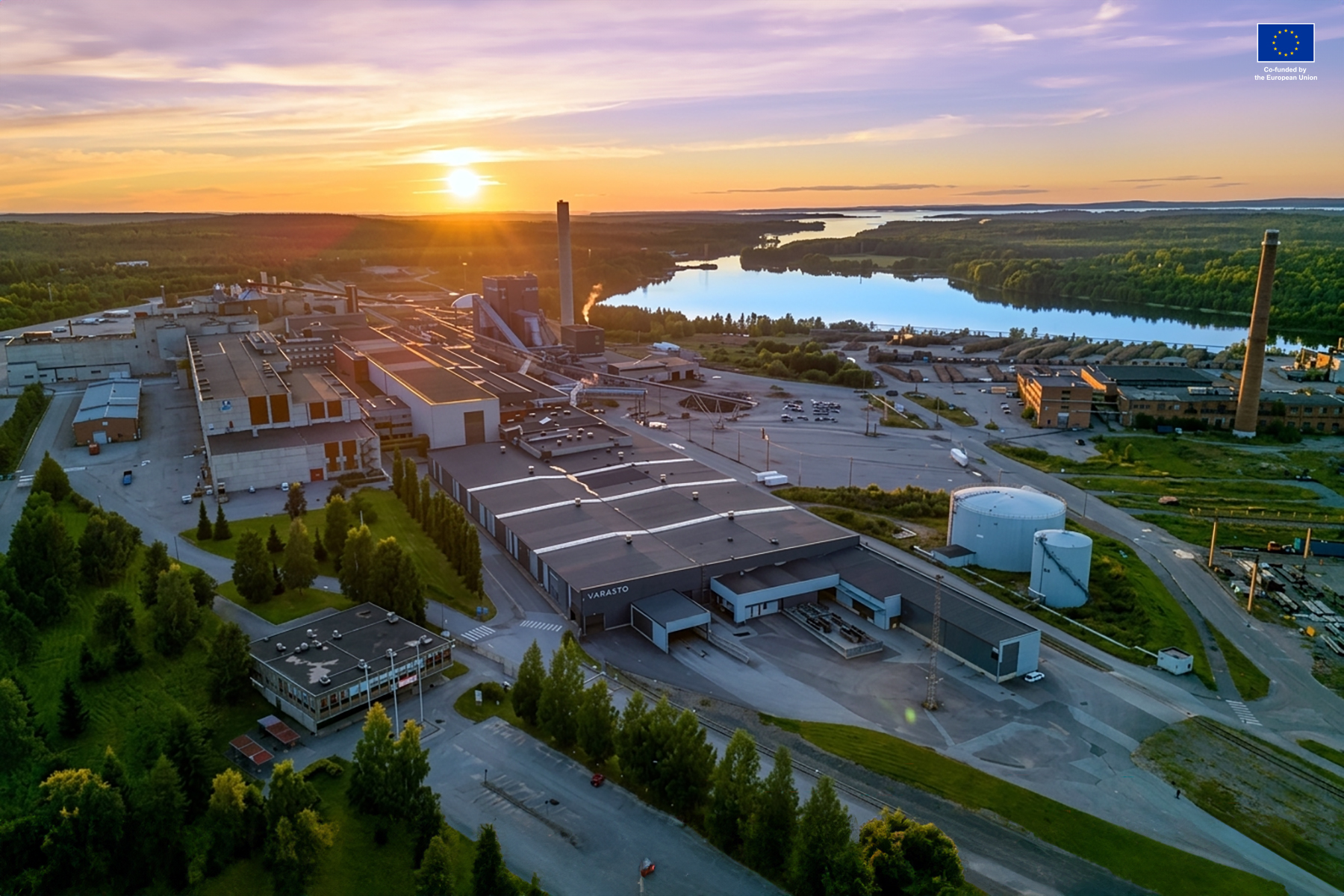
CSC – IT Center for Science, a Finnish research infrastructure organisation, has agreed with regional energy company Loiste Lämpö Oy to recover and redirect waste heat from the new LUMI AI Factory data centre into the district heating network serving the city of Kajaani in northern Finland, according to an announcement published on 23 April. The deal is expected to “significantly increase” the proportion of the city’s district heating drawn from data centre heat, the two organisations said.
The LUMI AI Factory data centre is currently under construction inside a former paper mill at the Renforsin Ranta business area in Kajaani. Construction began in January 2026 and the facility is expected to reach operational readiness in the second half of 2027, according to CSC. Once live, excess heat from the data centre will be routed through a Loiste heat pump plant before entering the district heating grid.
A supercomputer for AI — and the homes nearby
The LUMI AI Factory is the largest of the 19 AI supercomputing facilities being established across the European Union. It is coordinated by CSC and backed by a consortium of six countries — Finland, Norway, Poland, Denmark, the Czech Republic, and Estonia — with Belgium, Iceland, Latvia, and Switzerland participating as associate members. The facility will house LUMI-AI, a new AI-focused supercomputer, and LUMI-IQ, an experimental quantum computing platform, both of which will succeed the current LUMI supercomputer once its operational lifecycle ends.
The arrangement announced this week mirrors one already in place for the original LUMI system. When CSC and Loiste signed a predecessor agreement in 2020, they projected that the LUMI data centre’s waste heat would cover roughly 20 per cent of Kajaani’s total district heating need, according to information published at the time on the LUMI website. The new facility is expected to produce considerably more heat given its larger scale and higher power density.
“A data centre is an excellent source of excess heat because it produces heat consistently throughout the year, and this heat can be utilised in district heating production. Loiste’s strategic objective to reduce emissions from heat production is progressing well thanks to the cooperation between CSC and Loiste,” said Marko Saviniemi, Director of heat business at Loiste, in a statement.
Loiste Lämpö Oy is the district heating subsidiary of Loiste, a Finnish energy group with more than a century of history in the Kainuu region of north-central Finland. The company produces and distributes district heat across the Kajaani area, with most supply generated at the Kainuun Voima cogeneration plant, according to company information. The district heating network covers approximately 70 per cent of Kajaani residents’ heating needs.
Environmental ambitions built in from the start
Like its predecessor, the LUMI AI Factory data centre is designed to run on fully carbon-free renewable energy and to recover heat as comprehensively as possible, according to CSC. The Kajaani site has been cited by CSC and the LUMI consortium as one of the most energy-efficient locations for large-scale supercomputing in the world, owing to the cool northern climate, reliable power grid, and the existing infrastructure for liquid-cooled systems.
“We aim to build data centres that are as environmentally friendly and energy efficient as possible. That is why the heat generated by the LUMI AI Factory data centre and the new supercomputer to be installed there will be utilised as comprehensively as possible. The agreement now signed supports this objective,” said Juha Oinonen, Director responsible for data centres and networks at CSC.
The broader LUMI AI Factory project is one of the EU’s 19 AI factories — a network of facilities designed to give European researchers, startups, and companies access to large-scale AI computing capacity, high-quality datasets, and specialist expertise from a single platform. In Finland, Aalto University, AI Finland, and the University of Helsinki are part of the consortium alongside CSC.
Kajaani’s growing role in European computing
Like its predecessor, the LUMI AI Factory data centre is designed to run on fully carbon-free renewable energy and to recover heat as comprehensively as possible, according to CSC. The Kajaani site has been cited by CSC and the LUMI consortium as one of the most energy-efficient locations for large-scale supercomputing in the world, owing to the cool northern climate, reliable power grid, and the existing infrastructure for liquid-cooled systems.
“We aim to build data centres that are as environmentally friendly and energy efficient as possible. That is why the heat generated by the LUMI AI Factory data centre and the new supercomputer to be installed there will be utilised as comprehensively as possible. The agreement now signed supports this objective,” said Juha Oinonen, Director responsible for data centres and networks at CSC.
The broader LUMI AI Factory project is one of the EU’s 19 AI factories — a network of facilities designed to give European researchers, startups, and companies access to large-scale AI computing capacity, high-quality datasets, and specialist expertise from a single platform. In Finland, Aalto University, AI Finland, and the University of Helsinki are part of the consortium alongside CSC.