

NestAI to train sovereign AI models for European defence, as Finland and Estonia pilot first systems
Finnish defence AI company NestAI has begun training frontier AI models specifically for battlefield use, with the Finnish and Estonian defence forces set to pilot the first versions under a cooperation agreement signed in June — the clearest sign yet of Europe’s push to build its own military AI rather than rely on models developed elsewhere.
Text by Martti Asikainen, 14.7.2026 | Photo by Finnish Defence Forces
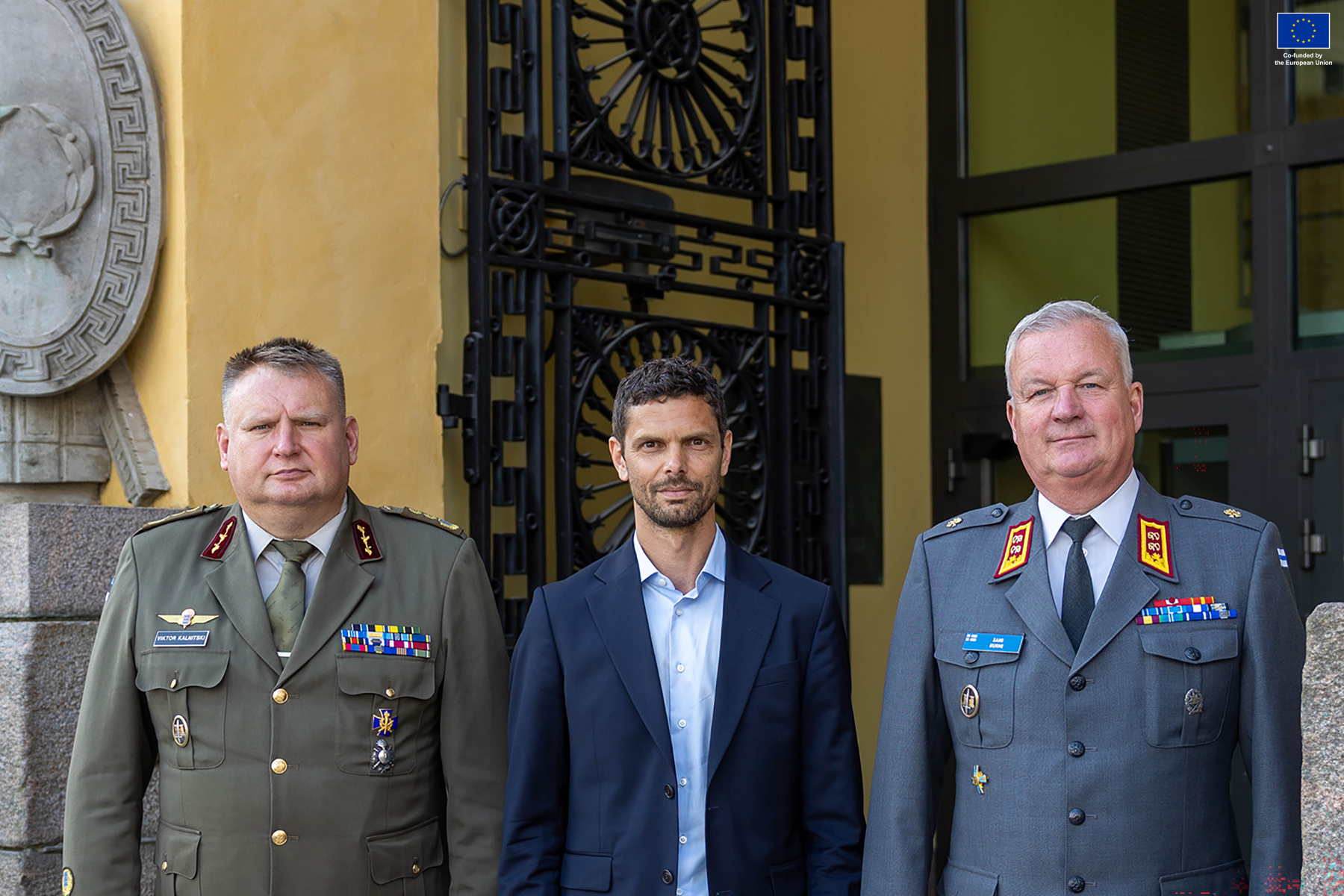
NestAI, a Finland-based AI company for defence applications, said on 14 July that it has begun training its own AI models for battlefield autonomy and command, rather than relying on adapted commercial or foreign-built models, according to a post published on the company’s website.
The initial models cover two areas: autonomy for decisions unmanned systems make independently, and orchestration for command across a military force. Access to pilot the first models will go to Finland’s defence AI unit and its Estonian counterpart, under the trilateral letter of intent Finland, Estonia and NestAI signed on 30 June, according to a press release issued by the Finnish Defence Forces.
The June agreement
The letter of intent carries no financial commitment, according to the Finnish Defence Forces. It instead establishes a framework for knowledge-sharing, joint development, training and technical cooperation between Finland’s defence AI unit and Estonia’s Force Transformation Command, which has a similar remit.
The initial focus is on adaptive and learning AI, command-and-control support, and autonomous and unmanned systems, built on open architecture intended to avoid dependence on a single vendor, the Finnish Defence Forces said. The cooperation is being rolled out in phases, beginning with pilot projects before any wider expansion.
“This Letter of Intent is one element of the strategy’s objective to build a national and international ecosystem around data and artificial intelligence,” said Major General Sami Nurmi, deputy chief of staff for strategy at Finland’s Defence Command, adding that Finland aims to bring further nations into the cooperation.
Major General Viktor Kalnitski, deputy commander of the Estonian Defence Forces, said the agreement “establishes a basis for practical cooperation in military artificial intelligence,” and that combining operational insight with shared testing experience is expected to accelerate the responsible adoption of AI in command-and-control and unmanned systems, whilst preserving what he called sovereign control over data and technology.
How the models are being trained
NestAI said the models draw on two sources of data: operational data generated by NestOS, its existing battlefield operating system, already deployed with defence forces and industry partners; and synthetic data produced by a tool called NestOS Engine, designed to simulate conditions too rare, too dangerous, or not yet encountered.
Training and testing, the company said, are run in simulation, pitting systems against a modelled adversary in a digital recreation of the terrain and conditions on what it calls Europe’s eastern flank. NestAI said models are ultimately judged against real conditions and operators rather than simulation benchmarks alone, though it did not specify what that validation process involves.
“Defence is different. It requires more than just LLMs,” said Peter Sarlin, founder and executive chairman of NestAI. “After a decade and tens of billions of dollars into self-driving vehicles, autonomy still only works in mapped, well-regulated areas. A road is a forgiving environment, with lanes and rules. The battlefield is the opposite, contested and unstructured, with an adversary working in real time to defeat whatever you field.”
Sarlin said the aim is a model that operates within limits tied to military doctrine and rules of engagement, with decisions that can be reviewed afterwards, whilst leaving the extent of any autonomy granted to unmanned systems as a decision for military commanders.
Wider build-out
NestAI said the model-training effort involves the US chipmaker AMD, the European AI research network ELLIS, the Finnish Defence Forces, and the LUMI AI Factory, a supercomputing resource.
A separate company, Qutwo, is contributing quantum-inspired compression techniques intended to allow large models to run within the power and computing limits of edge devices in the field. NestAI said it has assembled a dedicated model-development team within its wider workforce of close to 200 scientists and engineers, and that further model families are planned.
The model launch follows two other partnerships completed in recent months. NestAI agreed in May to integrate its software with unmanned aerial systems built by Finnish manufacturer Patria, and on 9 July unveiled a joint capability with Nokia combining 5G networks and sensing technology with NestOS.
NestAI, founded in 2025 by Sarlin — who previously built Finnish AI company Silo AI before its sale to AMD — has raised €100 million from Nokia and Finnish state investment company Tesi.