

Quantum computing is still at an early stage, but companies should start learning now
Finland already has quantum computers in use, with more on the way, but they are still small and error-prone, and useful calculations are years away. Even so, companies should start on two things now: moving to quantum-safe encryption and, if their business depends on molecules or materials, building the skills to use the machines.
Gintare Saali | 19.10.2026 | Photo by AI
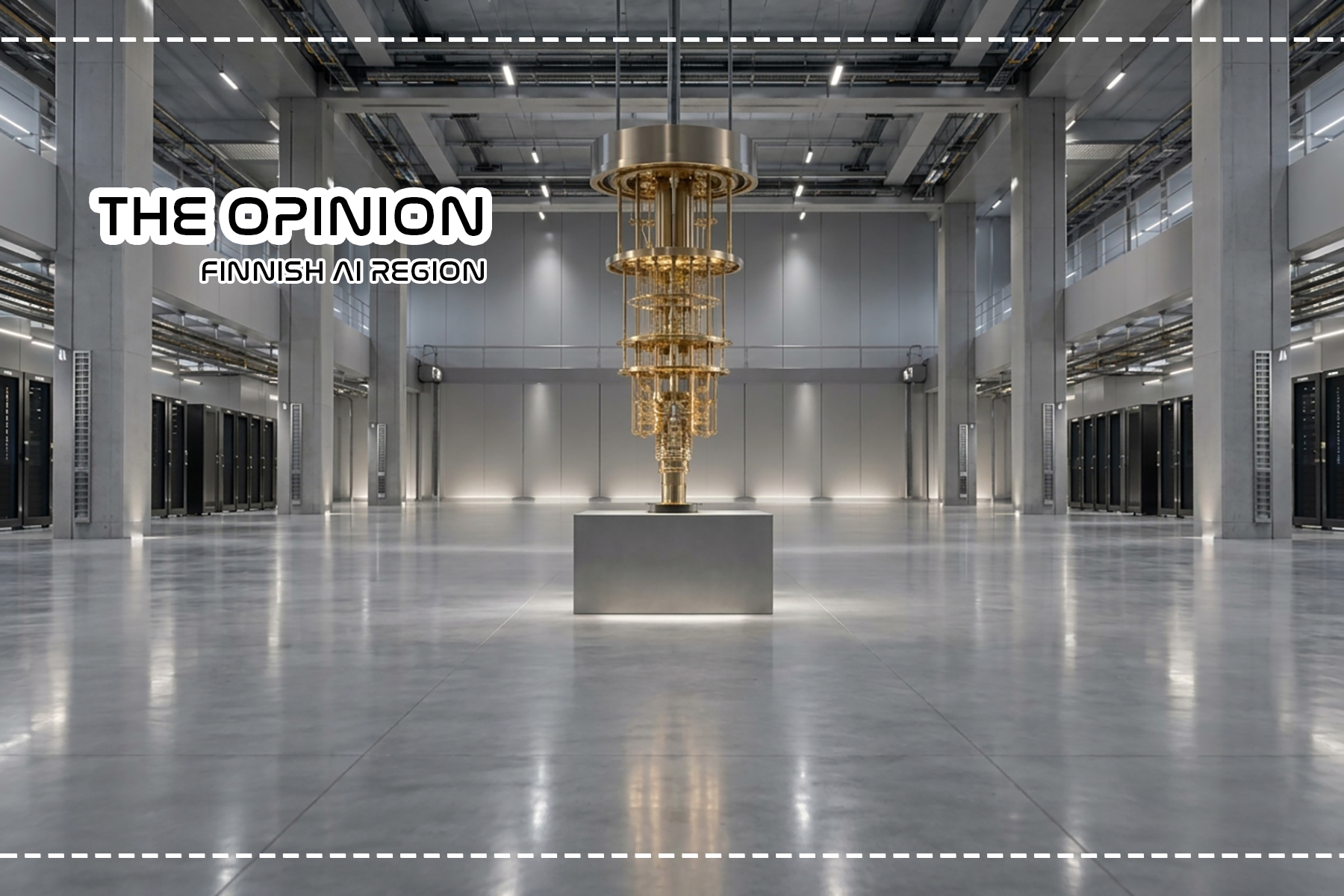
Quantum computers are often imagined as faster versions of today’s computers. In practice, they work on fundamentally different physical principles and suit a narrow set of problems, and for most tasks a conventional computer or a supercomputer will remain the better tool.
This article explains how the machines work, how far the technology has come, which machines are in use and being built in Finland, and what a company should do now. It draws on CSC’s course on quantum computing, on the quantum and post-quantum security sessions at VERGE Deep Tech in Helsinki on 29 September 2026, which the author attended, and on published sources.
AI was used to support language editing and structuring, while all content, ideas, and interpretations remain the author’s own. Photo created with AI
What a quantum computer is and what it can do
A conventional computer stores and processes everything as bits, each of which is either 0 or 1. A quantum computer, as explained by CSC’s experts (CSC 2026a), uses quantum bits (qubits), which differ from bits in several ways. Two of their key properties are superposition and entanglement. Superposition means that during a calculation, a qubit can be in a combination of 0 and 1. It settles into one definite value only when it is measured.
Entanglement means that qubits can be linked so that their values depend on one another. This is what lets them describe systems whose parts cannot be treated separately. A quantum method uses these properties to arrange the calculation so that wrong answers cancel each other out and the right answer is left when the qubits are measured. This works only for problems with the right mathematical structure (CSC n.d.; CSC 2026a).
The clearest example of where this helps is a molecule. The electrons in a molecule are themselves in superposition and entangled with one another. The number of their possible arrangements grows so fast with the size of the molecule that a few dozen electrons are already too many for any supercomputer to describe exactly.
Qubits behave in the same way as the electrons they describe, so a quantum computer can represent the molecule directly instead of approximating it. This is why the most promising uses lie where the question is how electrons arrange themselves: finding new materials for batteries, catalysts for the chemical industry, and candidate molecules for medicines (CSC 2026a).
Where a quantum computer is faster, the gain is called a quantum speed-up. As Hoefler et al. (2023) explain, it belongs to a particular method for a particular problem rather than to the machine as a whole. As the problem grows, the quantum method needs far fewer steps than the best known conventional method. For a few problems, the difference is so large that cases too big for any conventional computer come within reach.
The simulation of molecules and materials is the main example. For many other problems, the known gain is modest. Because each step on an error-corrected quantum computer is far slower than on a conventional chip, a modest gain is unlikely to pay off in practice. A quantum computer also reads and writes data very slowly, so it suits problems with a small input and a very large number of calculations (Hoefler et al. 2023).
Optimization and quantum-enhanced AI are both named as aims for one of Finland’s next quantum computers, LUMI-IQ (CSC 2026b). They remain research goals: no clear practical benefit, such as a faster or cheaper result than a conventional computer gives, has yet been demonstrated. The companies that build the machines describe a wider field. In his VERGE keynote (Epicenter 2026), Jouni Flyktman of IQM estimated that at least half of the workloads now run on supercomputers could be moved to quantum computers and run faster.
This goes well beyond what Hoefler et al. consider realistic, although he also said that more problem classes in which value can be shown are still needed. At the same event, Costantino Carugno of VTT gave a narrower rule: “quantum becomes useful when the bottleneck is model representation”. If more computing power were all that was needed, one would build a larger supercomputer instead (Epicenter 2026).
How far the technology has come
Today’s quantum computers are small and make frequent errors. As the CSC course explained (CSC 2026a), qubits are disturbed by material defects, heat, cosmic rays and other outside influences, so every operation has a small chance of going wrong. In a calculation of practical length, the errors add up until the result is noise. The known remedy is error correction, in which many physical qubits work together as one logical qubit that detects and corrects its own errors (CSC 2026a).
Rini and Schirber (2024) report that in December 2024 a Google team made an important step with its 105-qubit Willow chip. The team showed that the error rate of one logical qubit halved each time the group of physical qubits was enlarged, from 9 to 25 to 49 data qubits. The experiment stored a single qubit of information but did not calculate with it (Rini & Schirber 2024).
The main obstacle has thus been shown to be solvable in principle, but a machine that calculates reliably with logical qubits does not yet exist. Current experiments instead rely on statistical techniques that reduce noise in short calculations on physical qubits. These techniques do not scale to long, practical computations.
Readers will come across news that a quantum computer has done something no ordinary computer can. Such “quantum advantage” was first claimed in 2019, and several experiments have repeated the claim since then. Researchers still do not agree on whether it has really been reached (Hangleiter 2026).
One of the most recent results was published in July 2026 by IBM and its partners, including the Helsinki- and Milan-based company Algorithmiq. It concerns simulations of physics and test problems rather than business problems. Its main contribution is a set of methods for checking a quantum computer’s answer when no conventional computer can (Quantum Computing Report 2026a).
The Finnish results are of the same kind. At VERGE, Flyktman showed an IQM machine giving a small improvement in accuracy over conventional methods for a few molecules it was tested on. He added that the practical value is still limited because the molecules are so small (Epicenter 2026). For a company, such news is a sign of progress in research, not yet a sign that the machines can be used for practical work.
How far the machines still have to go is perhaps best measured in logical qubits. In September 2026, the US Department of Energy launched a competition for a first scientifically useful quantum computer. Its target is a machine with at least 100 logical qubits that can run hundreds of millions of reliable operations for chemistry, materials, physics, and applied mathematics (U.S. Department of Energy 2026).
Its advisory committee expects the first scientific demonstrations, with about 50 to 100 logical qubits, to concern small pieces of molecules rather than whole ones (Swayne 2026). The machines must become many times larger and more reliable before the first useful calculations can be expected.
Quantum computers in Finland and what is being built next
The machines in Finland are used through FiQCI, the national quantum computing infrastructure maintained by VTT, Aalto University and CSC (FiQCI n.d.). FiQCI currently offers two quantum computers in Finland. VTT Q50 is a 53-physical-qubit machine operated by VTT. Aalto Q20 is a 20-physical-qubit machine that Aalto University built for research and teaching and opened in March 2026 (FiQCI n.d.; Aalto University 2026).
A third machine, the 24-physical-qubit LUMI-Q VLQ in Czechia, is being added. Finland’s first quantum computer, the 5-physical-qubit VTT Q5 known as Helmi, started in 2021 and was decommissioned in 2026 (FiQCI n.d.; CSC n.d.). Researchers at Finnish universities and research institutes apply for time on the machines through FiQCI calls. Companies can get cloud access to VTT Q50 directly from VTT (FiQCI n.d.; VTT n.d.).
The next generation of Finnish machines is being built on two tracks. VTT is acquiring larger machines of its own with national funding. Meanwhile, the LUMI supercomputing environment in Kajaani is getting LUMI-IQ, a European machine funded through the EuroHPC Joint Undertaking (VTT 2025; CSC 2026b).
On the VTT track, VTT ordered a two-stage superconducting quantum system from IQM in May 2025. It is financed by a special government grant of EUR 70 million. The system will expand from 150 physical qubits in 2026 to 300 physical qubits in late 2027 and will be connected to the Finnish supercomputing infrastructure (VTT 2025).
The delivery includes a cloud platform through which companies and university researchers can use the machines, and VTT will grant limited free computing time to qualifying applications. Part of the project is to work out how to adapt quantum computers to the methods used in material modelling, a field in which Finland already has strong expertise (VTT 2025). The first 150-qubit machine arrived at VTT in October 2026 and is now being installed. A second one, due in 2027, will be connected to it to form the 300-qubit system (VTT 2026).
On the LUMI track, LUMI-IQ is built as a research and development platform. The emphasis is on error correction and on combining quantum computing with AI and supercomputing (CSC 2026b). In July 2026, IQM was selected to supply it to the LUMI AI Factory in Kajaani. The machine is funded by the EuroHPC Joint Undertaking together with Finland, Czechia, Norway and Poland.
The first system, with 150 physical qubits, is due in autumn 2027. Upgrades in 2028 will improve error correction, and a final upgrade in 2029 will bring more advanced logical qubits. The system will be open to R&D projects of universities and companies, including small and medium-sized companies. Users will get support, training, and a software library for adding quantum steps to existing AI workflows (CSC n.d.; CSC 2026b).
The final configuration is expected to run up to nine logical qubits. The first scientific demonstrations are expected to need 50 to 100 (Quantum Computing Report 2026b; Swayne 2026). In its first years, LUMI-IQ will be a place for companies to build skills and try out methods on small problems.
What a company should do now
The right steps depend on whether a company needs to protect its data against future quantum computers or prepare to use them. The first concerns almost every company. The second concerns only those whose problems are themselves quantum mechanical, such as how molecules and materials behave.
1. Protecting data
The encryption methods at risk are in use everywhere: online banking, cloud services and websites all rely on them. A large enough quantum computer could break the public-key encryption that protects most internet traffic, banking and digital signatures today. No such machine exists yet, but a survey of 26 experts put the probability of one within ten years at 28–49 percent (Mosca & Piani 2026).
This is the same kind of speed-up as in the simulation of molecules. The mathematical problem that public-key encryption relies on is one of the few for which a quantum method needs dramatically fewer steps than the best known conventional method (Hoefler et al. 2023).
The problem is current because confidential data intercepted or stolen today in encrypted form can be stored and opened later. The National Cyber Security Centre Finland advises organizations to begin immediately. They should list where they use public-key encryption and digital signatures and assess which of their data must stay confidential for a long time (Traficom 2026).
The replacement methods already exist. The first post-quantum encryption standards were published in August 2024: FIPS 203 (ML-KEM) for key establishment, and FIPS 204 (ML-DSA) and FIPS 205 (SLH-DSA) for digital signatures (NIST 2024). European authorities recommend hybrid post-quantum/traditional schemes during the transition. Traficom follows the EU Coordinated Implementation Roadmap for post-quantum cryptography alongside NIS2 cybersecurity obligations.
The roadmap sets three deadlines: transition plans in place by the end of 2026; high-risk systems, such as critical infrastructure and systems protecting long-term confidential data, migrated by the end of 2030; and the rest by 2035 (Traficom 2026).
The post-quantum security panel at VERGE (Epicenter 2026) was blunt about how far companies are from this. Suvi Lampila of SSH Communications Security said that none of the companies in the room could produce a full inventory of where they rely on RSA, elliptic-curve cryptography, certificates and keys.
The reason, she said, is that “pretty much everything the past 30 years they’ve used that needed to have confidentiality and needed to have authentication needs to be updated”. She called the change the biggest cryptographic migration in history. The inventory will never be complete, she said, and it is not a prerequisite for starting, “so don’t use that as an excuse”.
Her advice to a management team was to ask first, for each type of data, whether a leak would be embarrassing or would end the business. Sini Ruohomaa of Ericsson advised starting with the encrypted connections used for email and web browsing, because every organization has them (Epicenter 2026).
For a small or medium-sized company, the practical steps are twofold. It should ask its IT, cloud and security suppliers when their products will support post-quantum encryption, and identify which of its own data must stay confidential for ten years or more (Traficom 2026).
2. Preparing to use the machines
The quantum panel at VERGE (Epicenter 2026) was equally forthright about the companies that should be preparing to use the machines. Finland now has two quantum companies, IQM and Bluefors, that have passed the billion-euro mark. Flyktman said the number of quantum companies in the country has grown from 3 to 22 since IQM was founded. Yet the panel also said that there are too few Finnish companies investing in the technology as users. Teemu Uotila of Quanscient, which builds quantum applications for industry, said that his company has done many customer projects, but only two customers had people who understood what is possible now and what will be possible later. “Let’s start small. That’s 85 percent of the discussions that we have” (Epicenter 2026).
Quantum computing is a large and complex field, and it is changing quickly. The experts at CSC described the technology as being at a very early stage, with much work remaining before it becomes an everyday tool. According to them, however, the pace of work is accelerating (CSC 2026a), and the material reviewed for this article points the same way. The knowledge needed to use the technology well takes years to build. It includes recognizing which problems fit, reducing them to a size the machines can handle, and judging vendor claims critically.
The advice from the VERGE panel (Epicenter 2026) was concrete. Bring a problem the company has already tried to solve on a conventional computer, with results to compare against. Assign a scientist or engineer to the work. Budget for one to three years rather than a quarter. Flyktman put the entry test in one sentence: “If you don’t have any computational problems, then you probably might not need quantum computing” (Epicenter 2026). Companies considering quantum computing, in particular those in chemistry, materials, medicines and energy, are advised to dedicate resources to building this knowledge now. That way they can judge the technology on their own terms when the first useful machines arrive. Practical starting points exist:
- Attending training courses (e.g., those organized by CSC).
- Accessing current Finnish quantum hardware through VTT’s commercial access services, or starting collaborative R&D projects with Finnish universities or research institutes.
- Using the classical quantum circuit emulators on CSC’s LUMI supercomputer. They are open to all LUMI users and can simulate circuits of up to roughly 44–45 qubits. Algorithms can be developed and checked on them without noise before being run on physical quantum hardware to test larger circuits and error mitigation (Mucciardi & Johansson 2025).
Author

References
Aalto University. (2026, 11 March). Aalto University unveils AaltoQ20 – a state-of-the-art quantum computer for educating quantum talent of the future. Aalto University. Accessed 13 October 2026.
CSC. (n.d.). Quantum computing. CSC – IT Center for Science. Accessed 13 October 2026.
CSC. (2026a). Introduction to quantum computing. Two-day course, autumn 2026. CSC – IT Center for Science. Author’s own notes from the course.
CSC. (2026b, 8 July). IQM selected to deliver the LUMI-IQ quantum computer. CSC. Accessed 13 October 2026.
Epicenter. (2026, 29 September). VERGE | Deep Tech: Beyond the Screen. Into the Bedrock. Event at Epicenter Helsinki. Author’s notes from the sessions.
FiQCI. (n.d.). Get access. Finnish Quantum-Computing Infrastructure. Accessed 13 October 2026.
Hangleiter, D. (2026). Has quantum advantage been achieved? arXiv:2603.09901.
Hoefler, T., Häner, T. & Troyer, M. (2023). Disentangling hype from practicality: On realistically achieving quantum advantage. Communications of the ACM, 66(5), 82–87.
Mosca, M. & Piani, M. (2026). Quantum Threat Timeline Report 2025. Global Risk Institute.
Mucciardi, M. & Johansson, M. (2025, 29 April). LUMI enables simulations of large-scale algorithms for quantum advantage. CSC – IT Center for Science. Accessed 15 October 2026.
NIST. (2024, 13 August). NIST releases first 3 finalized post-quantum encryption standards. National Institute of Standards and Technology. Accessed 13 October 2026.
Quantum Computing Report. (2026a, 30 July). IBM and ecosystem partners demonstrate “trusted quantum advantage” beyond classical supercomputers. Quantum Computing Report. Accessed 13 October 2026.
Quantum Computing Report. (2026b, 10 September). LUMI AI Factory selects IQM’s Halocene roadmap for Europe’s first superconducting logical qubit system. Quantum Computing Report. Accessed 13 October 2026.
Rini, M. & Schirber, M. (2024, 9 December). Cracking the challenge of quantum error correction. Physics, 17, 176. American Physical Society. Accessed 13 October 2026.
Swayne, M. (2026, 19 September). DOE panel ties future national quantum facility to proof of scientific use. The Quantum Insider. Accessed 13 October 2026.
Traficom. (2026, 13 October). Siirtymä kvanttiturvallisiin salausmenetelmiin [Transition to quantum-safe encryption methods]. Kyberturvallisuuskeskus, Traficom. Accessed 15 October 2026.
U.S. Department of Energy. (2026, 17 September). DOE launches competition to accelerate development of world’s first fault-tolerant quantum computer. Office of Science. Accessed 13 October 2026.
VTT. (n.d.). Quantum computing. VTT Technical Research Centre of Finland. Accessed 13 October 2026.
VTT. (2025, 20 May). IQM Quantum Computers to supply Finland with a world-leading superconducting 300-qubit quantum computer. VTT Technical Research Centre of Finland. Accessed 15 October 2026.
VTT. (2026, 6 October). Our 150-qubit quantum computer has been unboxed at VTT [LinkedIn post]. VTT Technical Research Centre of Finland. Accessed 15 October 2026.