Nearly One-Third of Europeans Now Using Generative AI Tools - Small Nations Lead the Way
Nordic and Baltic countries dominate AI adoption rankings with usage rates approaching 50%, whilst Eastern European nations lag significantly behind with less than a quarter of their populations using the technology.
Text by Martti Asikainen, 8.1.2026 | Photo by Adobe Stock Photos
Almost one in three Europeans have embraced generative artificial intelligence technology, according to new data released by Eurostat, marking a significant milestone in the digital transformation sweeping across the continent.
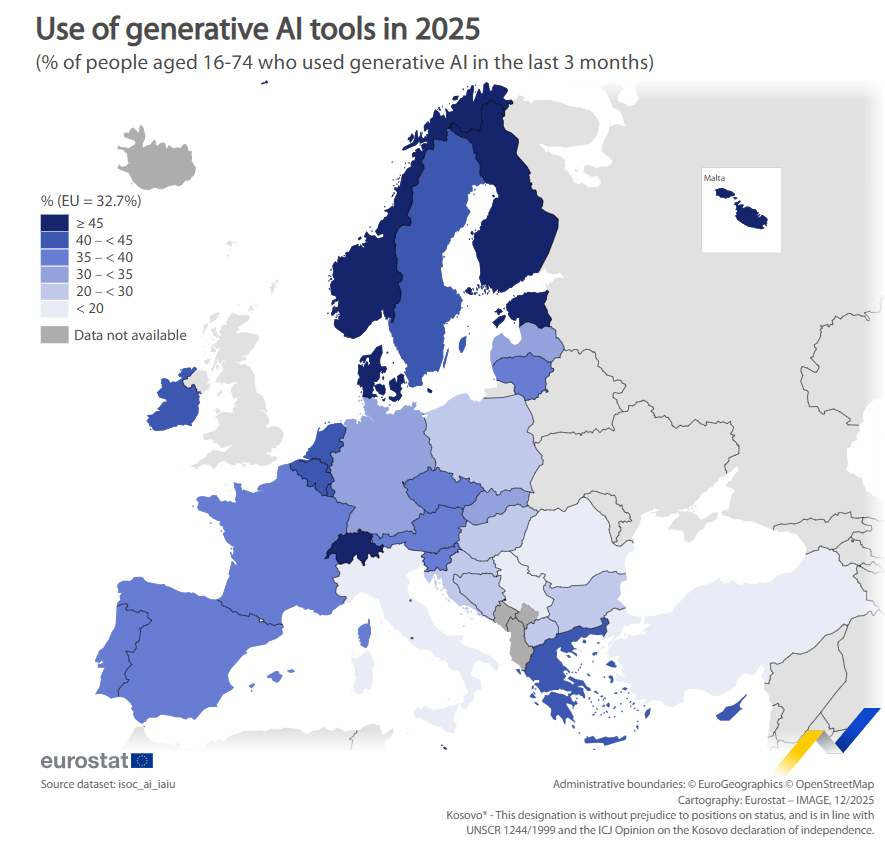
The statistics reveal that 32.7% of people aged 16-74 in the European Union used generative AI tools in 2025, with most utilising these technologies for personal purposes rather than professional or educational applications.
The data shows a clear preference for personal applications, with 25.1% of EU residents using AI tools for personal purposes, whilst 15.1% employed them for work-related tasks and 9.4% for formal education. This suggests that generative AI technologies—which can create text, images, programming code, videos, and other content based on user prompts—are becoming increasingly integrated into everyday life.
Small Countries Lead Adoption
Among European Union member states, Denmark emerged as the clear leader with a utilisation rate of 48.4 %. Estonia followed closely with 46.6 % and Malta third with 46.5 %.
Finland rounded out the top three at 46.3 %. However, Norway stands apart as the true leader in Europe, with an impressive 56.3 % adoption rate. Switzerland also has a notable utilisation rate of 47.0 %.
The Nordic and Baltic regions demonstrated particularly strong uptake of AI technologies, reflecting their reputation as digital pioneers within Europe. These countries have historically shown high levels of digital literacy and technological infrastructure, factors that appear to correlate with faster AI adoption rates.
At the opposite end of the spectrum, Romania recorded the lowest usage rate at just 17.8%, followed by Italy at 19.9% and Bulgaria at 22.5%. This disparity highlights a continuing digital divide within the European Union, with newer member states and Southern European countries showing more hesitant adoption of emerging technologies.
Implications for Digital Policy
The findings come as European policymakers continue to debate regulations surrounding artificial intelligence, including the recently adopted EU AI Act. The data suggests that whilst AI adoption is growing rapidly across the continent, significant work remains to ensure equitable access to these technologies.
The 2025 survey results are based on the EU’s ongoing research into ICT usage in households, with data collected over the three months prior to the survey period. As generative AI tools continue to evolve and become more accessible, experts anticipate these adoption rates will continue to climb in coming years.
For policymakers and businesses alike, the data provides crucial insights into which populations are embracing AI technologies and where additional education, infrastructure, or support may be needed to prevent further digital divides from emerging across the European Union.