

ConfidentialMind Secured Growth Funding with Support from FAIR
ConfidentialMind provides companies and organizations with secure and flexible solutions for leveraging generative artificial intelligence within their own IT environments. The service ensures that corporate data remains under the customer’s control and avoids dependency on the data centers of large cloud service providers.
Text by Eemeli Sarka, 13.3.2026 | Photo by Eemeli Sarka
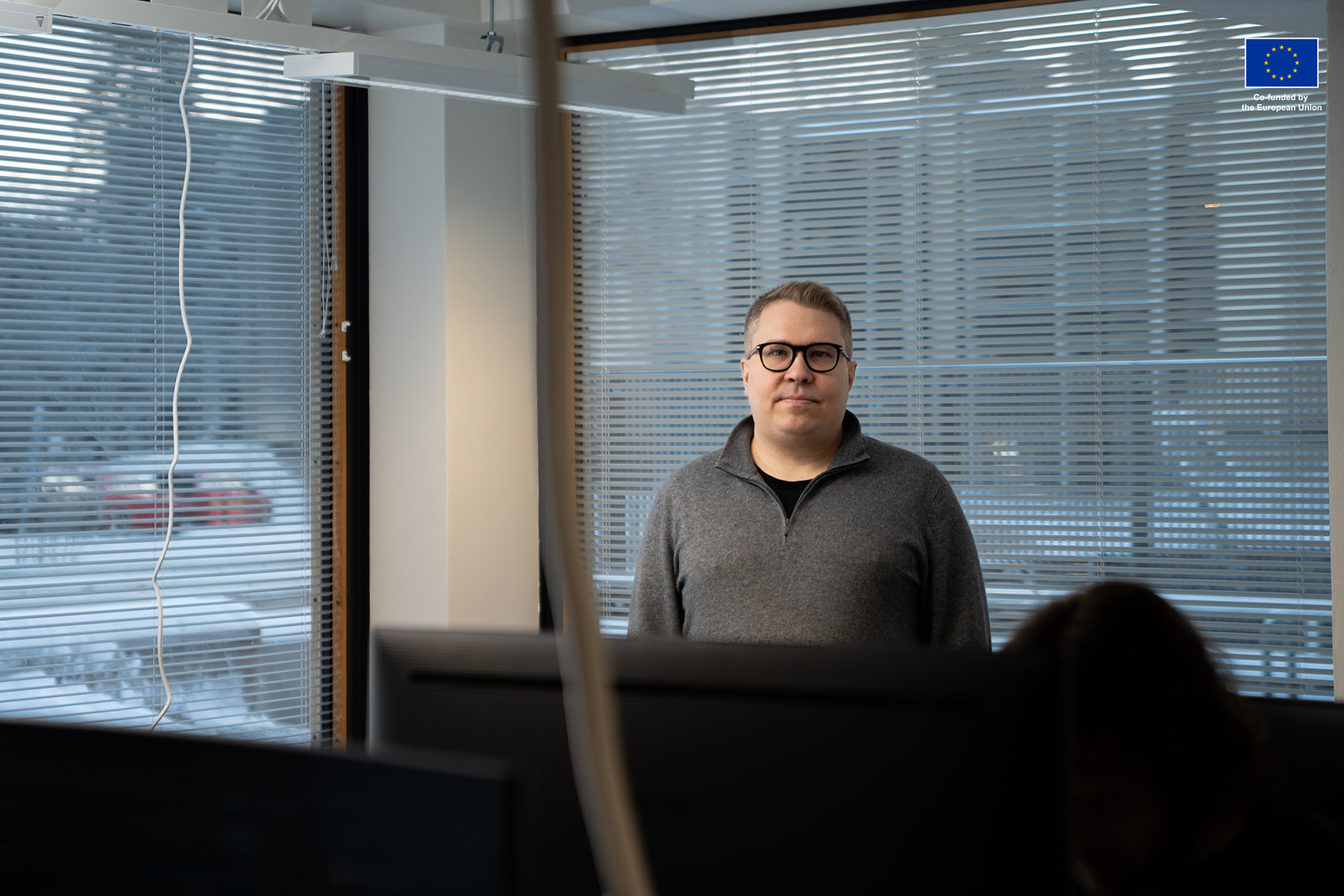
When ConfidentialMind’s three founders, Markku Räsänen, Severi Tikkala, and Esko Vähämäki, decided to establish their own company in 2023, they already had extensive experience in developing backend systems. Their goal was to address a challenge familiar to many software developers, one they had encountered themselves.
– Cloud service providers typically offer a wide range of separate tools — such as databases, AI services, and document scanning — that are very easy to use. However, because each provider builds its own proprietary tools, using them creates a so-called vendor lock-in situation. This makes it difficult to switch providers, as the tools are not standardized, explains CEO Markku Räsänen.
As generative AI applications were rapidly becoming more common in 2023, it was a natural step to develop a service that allows companies to build AI capabilities into their own products without becoming dependent on major cloud providers. ConfidentialMind therefore offers an intermediary cloud layer on top of which customers can develop their own applications, without being locked into ecosystems such as Google’s or Microsoft’s.
– In addition to freedom of choice, our service ensures that company data remains completely private. With our software, organizations can build private cloud environments where everything from hardware to data and AI services is fully under their control. This allows companies to manage exactly how data is fed into AI models and to process information that they do not want to share with third parties.
Funding as a Prerequisite for Growth
According to Räsänen, securing funding in the early stages was challenging, as infrastructure software companies of this type are rarely founded in Europe. Such companies typically originate in the United States, where much of the global software ecosystem is built and where there is an established tradition of investing in infrastructure-focused startups.
– Our customers are large enterprises and governments, so our client base is largely international. When successful companies in this field have rarely emerged from Europe, there is a perception that they cannot be built here either, Räsänen notes.
FAIR’s networks proved valuable when the company needed opportunities to present its service to potential customers and investors. Through FAIR, ConfidentialMind was able to showcase its solution at the Knights of Nordics event, where technology startups meet investors shortly before Slush. FAIR also provided speaking opportunities at a themed webinar and a one-day technology event in Espoo.
– Events like these are an effective way to meet investors. Every opportunity to present your solution and tell your story is important for startups, as you never know who might be in the audience. Luck always plays a role in startup success, but high-quality events increase the likelihood of that luck.
Through these events, ConfidentialMind was able to raise funding and continue advancing its development. Equally important was FAIR’s role in bringing AI-focused companies together, helping guide product development in the right direction.
– In Europe, building startups is unfortunately more of a solitary effort than in the United States, where collaboration is more common and large companies are more willing to purchase services from startups. Organizations like FAIR help increase collaboration, communication, and the exchange of ideas, Räsänen reflects.

Europe vs. the United States
According to Räsänen, the lack of European infrastructure services is part of a broader trend. Over the past two decades, a significant share of technological development has been outsourced from Europe to the United States. American technology is widely used across Europe, from infrastructure systems and AI applications to smartphones and streaming services, and the origin of these services is rarely questioned.
– The issue is not a lack of expertise in Europe to develop comparable technologies. By effectively paying a continuous ‘tax’ to U.S. technology giants that own digital infrastructure, those companies can reinvest that revenue into further development — ensuring that we continue paying that tax. However, this is not a cycle that cannot be broken.
Räsänen argues that in most areas of modern technology development, Europe could reach near top-level performance if sufficient funding and skilled professionals were brought together. The question, therefore, is largely one of strategic intent.
As AI becomes increasingly embedded in government and corporate processes, disruptions to these technologies could have significant consequences.
– Technological infrastructure is also a means of control, especially if access to it can be restricted. No one wants a situation where the owner of critical infrastructure exerts pressure by threatening to deny access unless certain political conditions are met. In a less extreme case, prices could simply be raised significantly year after year. Europe is beginning to wake up to this future scenario as well, Räsänen concludes.
ConfidentialMind Oy is an Espoo-based start-up, which was awarded the AI Start-up of the Year 2024 prize at the AI Gala in October 2024.