Sauna, Silence, and Server Farms: Why Every Hyperscaler Has Finland on the Map Right Now
Finland has quietly become one of Europe’s fastest-growing data centre markets. A new report from DC Byte explains why — and what could derail it.
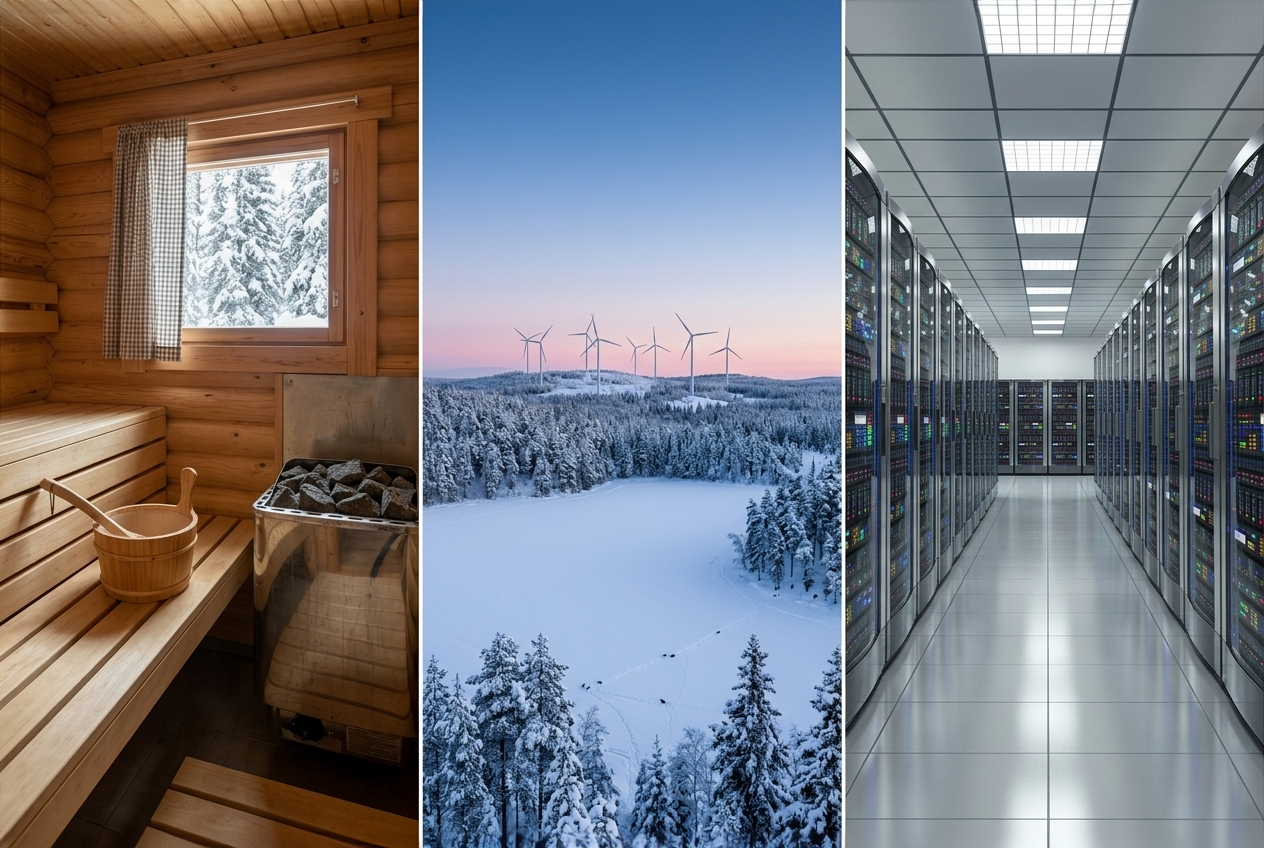
Text by Martti Asikainen, 22.5.2026 | Photo created with AI
Finland is no longer a footnote in European data centre conversations. According to a new analysis from DC Byte, the country has recorded a Total IT Load CAGR of over 70% between 2020 and 2025, making it the continent’s second-fastest growing market. Microsoft, Nscale, and DayOne are among the operators that have already committed to projects there, and thousands of additional megawatts are in the pipeline.
The reasons are straightforward. Finland offers cheap, clean power — its uniform price zone is the most competitive in the Nordics outside of Northern Norway — with 95% of its energy mix drawn from CO2-free sources.
Its national grid operator, Fingrid, actively prioritises data centre connections and offers positive usage guarantees, a sharp contrast to the multi-year grid queues that have stalled development in Dublin and Amsterdam.
Brownfield sites in municipalities like Kajaani, Kemi, and Mantsala are readily available, and state energy company Fortum has taken an active role in marketing them to incoming operators.
Waste Heat and Global Appeal
Finland is also emerging as a leader in waste heat reuse. As the largest district heat producer in the Nordics, it turns waste energy from closed pulp and paper sites into clean heat for local communities.
This model has since been replicated at Google’s Hamina campus, atNorth’s FIN04, the LUMI supercomputer in Kajaani, and Novagen’s Voikkaa data centre.
With the EU’s Energy Efficiency Directive tightening waste heat reporting requirements, that track record is becoming a meaningful competitive advantage.
The market’s appeal is also unusually broad. Unlike Sweden and Denmark, which DC Byte describes as saturated with US hyperscaler demand, Finland has attracted significant interest from APAC operators — including Chinese cloud and AI providers — drawn by its position as a connectivity bridge between Northern Europe and Asia.
One Tax Bill Away from a Chill
The biggest immediate threat is a proposed change to Finland’s electricity tax regime.
The government is considering removing the tax incentive for data centres entirely, which DC Byte says would increase the tax burden by around 45 times. The report points to Sweden as a warning: following early investment from Microsoft and AWS, Sweden scrapped its own incentives and saw market growth plateau shortly after.
Permitting is also a concern. Unlike Norway and Sweden, data centre power connections in Finland require court-issued building permits, a process that can take up to three years. And the market’s connectivity depends heavily on the C-Lion1 subsea cable, a 1,200km link to Germany on which data centres totalling 650 MW of capacity rely.
When the cable was severed in November 2024, it caused a short-term supply crunch — a reminder of how quickly infrastructure vulnerabilities can surface.
With 84% of Finland’s capacity still in early-stage development, the pipeline is promising but fragile. Whether it delivers depends largely on decisions being made in Helsinki right now.