

Finnish startup Quanscient raises €10m to bring AI to hardware engineering — the last frontier the technology has yet to transform
Tampere-based Quanscient has closed a Series A round backed by Europe’s largest dedicated quantum investment fund, betting that industrial design is overdue the same disruption AI delivered to software development.
Text by Martti Asikainen, 1.6.2026 | Photo by Quanscient
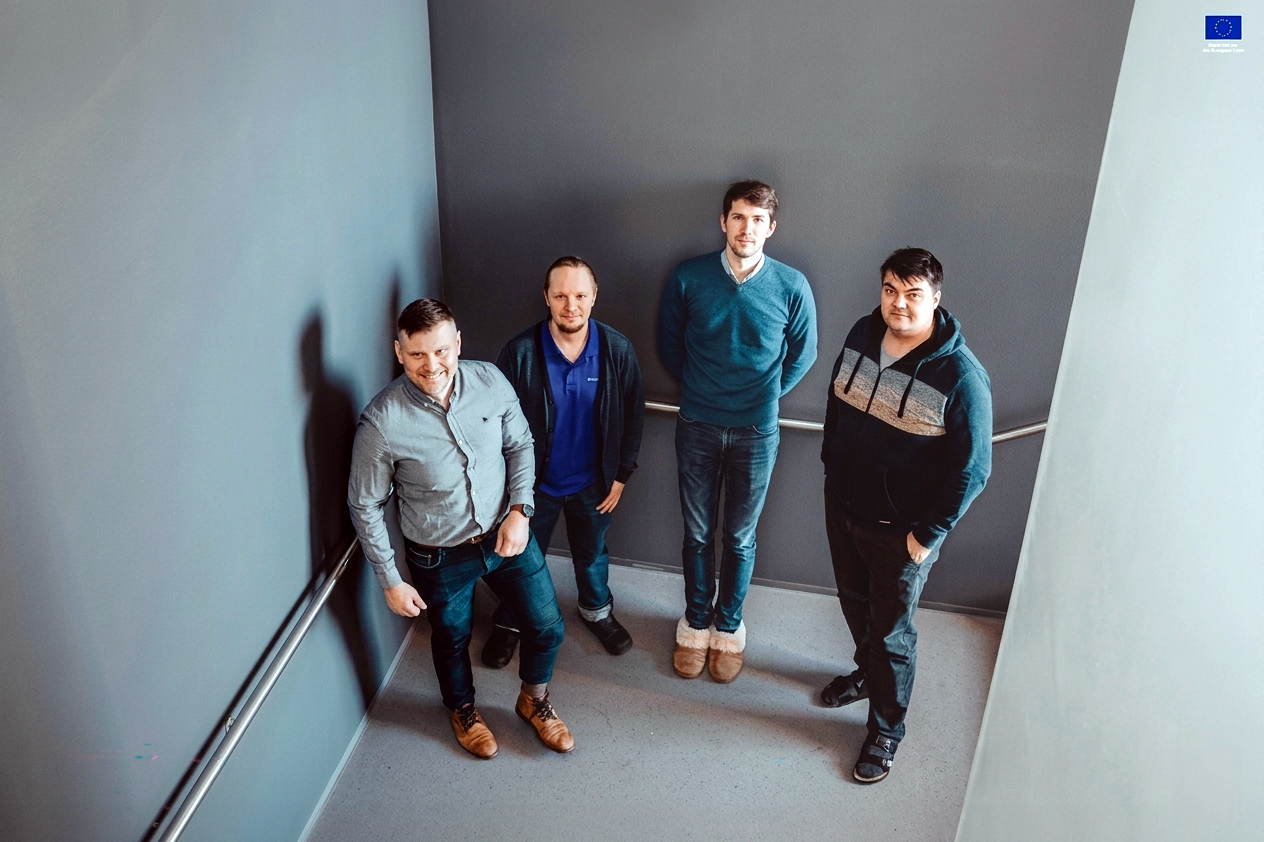
Tampere-based Quanscient has closed a Series A round backed by Europe’s largest dedicated quantum investment fund, betting that industrial design is overdue the same disruption AI delivered to software development.
Quanscient, a Finnish company founded in 2021 that builds cloud-based physics simulation software for industrial engineers, raised €10 million in a Series A round on 26 May, bringing its total funding to approximately €17.7 million across three rounds.
The deal was led by 55 North, a Copenhagen-based fund that describes itself as the world’s largest dedicated quantum venture vehicle, and Austrian industrial investor B&C Group, with existing backers Maki.vc, Crowberry Capital, QAI Ventures, and First Fellow Partners are all returning.
The funding will go towards international expansion and further development of a platform that its founders believe could do for physical product design what AI coding tools have done for software: compress years of iterative work into a continuous, automated process.
Why building things is still stuck in the past
Multiphysics simulation, the modelling of how heat, electromagnetism, fluid dynamics, and structural forces interact in a physical object, is central to designing everything from electric motors to aircraft and medical devices. At present, the process is slow, expensive, and largely opaque. An engineer typically creates a digital model in a computer-aided design tool and runs a handful of simulations to test a small number of variables. Each simulation can take days. If the result is unsatisfactory, the process begins again.
“I designed this, how does it work?” is how Juha Riippi, Quanscient’s co-founder and chief executive, described the current workflow in an interview with Yle, Finland’s national public broadcaster. “That leaves a huge number of potentially better design alternatives entirely untested.”
According to a study conducted by Quanscient itself, 89 per cent of engineers routinely simplify their physics models to fit within runtime budgets, a finding that, if accurate, suggests the industry is routinely accepting less precise models because the computing cost of higher accuracy is prohibitive. The figure comes from Quanscient’s own research, and independent verification of the survey methodology was not available at the time of writing.
Quanscient’s platform replaces desktop-based, case-by-case simulation with code-driven workflows on cloud infrastructure. Rather than running a handful of simulations, engineers can run thousands in parallel. The company claims runtimes up to 100 times faster than conventional tools. The resulting data is then used to train surrogate AI models, leaner predictive models that can estimate simulation outcomes in milliseconds once trained on a large enough physics dataset.
“AI will not transform hardware engineering unless simulation itself is rebuilt for it,” Riippi said in the company’s funding announcement. “By making multiphysics code-driven and cloud-scalable, we generate the volume of physics data that AI needs, turning simulation from a bottleneck into the engine of data-driven design.”
Riippi points to China as a reference point the West should take seriously. The Chinese automotive industry brings new models to market at a pace that has left Western observers astonished. “I don’t know their secrets, of course,” Riippi told Yle, “but I suspect there are considerably more advanced design processes behind it.”
Thousands of simulations in seconds
Quanscient’s platform replaces desktop-based, case-by-case simulation with code-driven workflows on cloud infrastructure. Rather than running a handful of simulations, engineers can run thousands in parallel.
The company claims runtimes up to 100 times faster than conventional tools. The resulting data is then used to train surrogate AI models, leaner predictive models that can estimate simulation outcomes in milliseconds once trained on a large enough physics dataset.
“AI will not transform hardware engineering unless simulation itself is rebuilt for it,” Riippi said in the company’s funding announcement. “By making multiphysics code-driven and cloud-scalable, we generate the volume of physics data that AI needs, turning simulation from a bottleneck into the engine of data-driven design.”
Riippi points to China as a reference point that the West should take seriously. The Chinese automotive industry brings new models to market at a pace that has left Western observers astonished. “I don’t know their secrets, of course,” Riippi told Yle, “but I suspect there are considerably more advanced design processes behind it.”
From aircraft to semiconductors — and beyond
Quanscient’s existing customers include Brazilian aircraft manufacturer Embraer, American medical device company Boston Scientific, and Infineon, Europe’s largest semiconductor manufacturer, according to Yle. A small number of Fortune 100 companies are also clients, though Riippi declined to name them.
The aerospace application is particularly striking. Riippi told Yle that developing a new aircraft model currently takes up to 12 years, during which manufacturers spend between €30 million and €150 million on wind tunnel testing, physical experiments in which models are exposed to artificial airflow to measure aerodynamic effects. A simulation capable of replacing those tests would represent substantial cost savings.
Full aerodynamic modelling at the level of precision required for aircraft design involves computational problems that current classical computing cannot practically solve. At cruising speed, the number of data points required to model a wing reaches approximately 10²⁴, a figure entirely beyond the reach of conventional hardware.
Quanscient maintains a quantum algorithms research team of seven people working on methods that could eventually unlock that scale of simulation, a team notably larger than the three people focused purely on AI development. According to Riippi, they are not competing technologies, but complementary ones.
World's largest quantum fund is taking notice
The lead investor itself is a notable signal. 55 North, headquartered in Copenhagen, announced the first close of its €300 million quantum fund in October 2025 at €134 million, and describes itself as the largest dedicated pure-play quantum venture vehicle in the world. Quanscient is one of the fund’s first publicly disclosed investments.
“Engineering teams are under pressure to explore much larger design spaces and more complex physics than legacy tools were built for,” said Helmut Katzgraber, Chief Science Officer and General Partner at 55 North, in the funding announcement. He said Quanscient’s platform gives customers “a future-proof step-change in throughput without sacrificing accuracy.”
Quanscient was founded by Juha Riippi, Valtteri Lahtinen, Alexandre Halbach, and Asser Lähdemäki, with Andrew Tweedie joining the founding team in 2024. The company currently employs around 40 people from 15 nationalities, with offices in Finland, Germany, the United Kingdom, the United States, and Japan.
The funding arrives as AI-assisted engineering tools attract growing investor interest globally, but the market remains at an early stage. The claim that AI has transformed software development, with Google’s chief executive Sundar Pichai saying in April that 75 per cent of new code at the company is now AI-generated, provides an evocative reference point for Quanscient’s pitch.
But physical product design operates under constraints that software does not: a poorly simulated motor or aircraft wing cannot simply be patched. The consequences of model inaccuracy are higher, and so is the bar for industrial customers to trust an AI-informed simulation over established methods.