

Business Finland approves €28 million grant for ICEYE’s satellite R&D, as company targets one hundred launches a year
The disbursement completes a multi-stage public grant programme for the Espoo-based radar satellite maker, which is now producing one satellite per week and is reported to be in talks to raise fresh capital at a valuation that could reach €5 billion.
Text by Martti Asikainen, 4.6.2026 | Photo by ICEYE
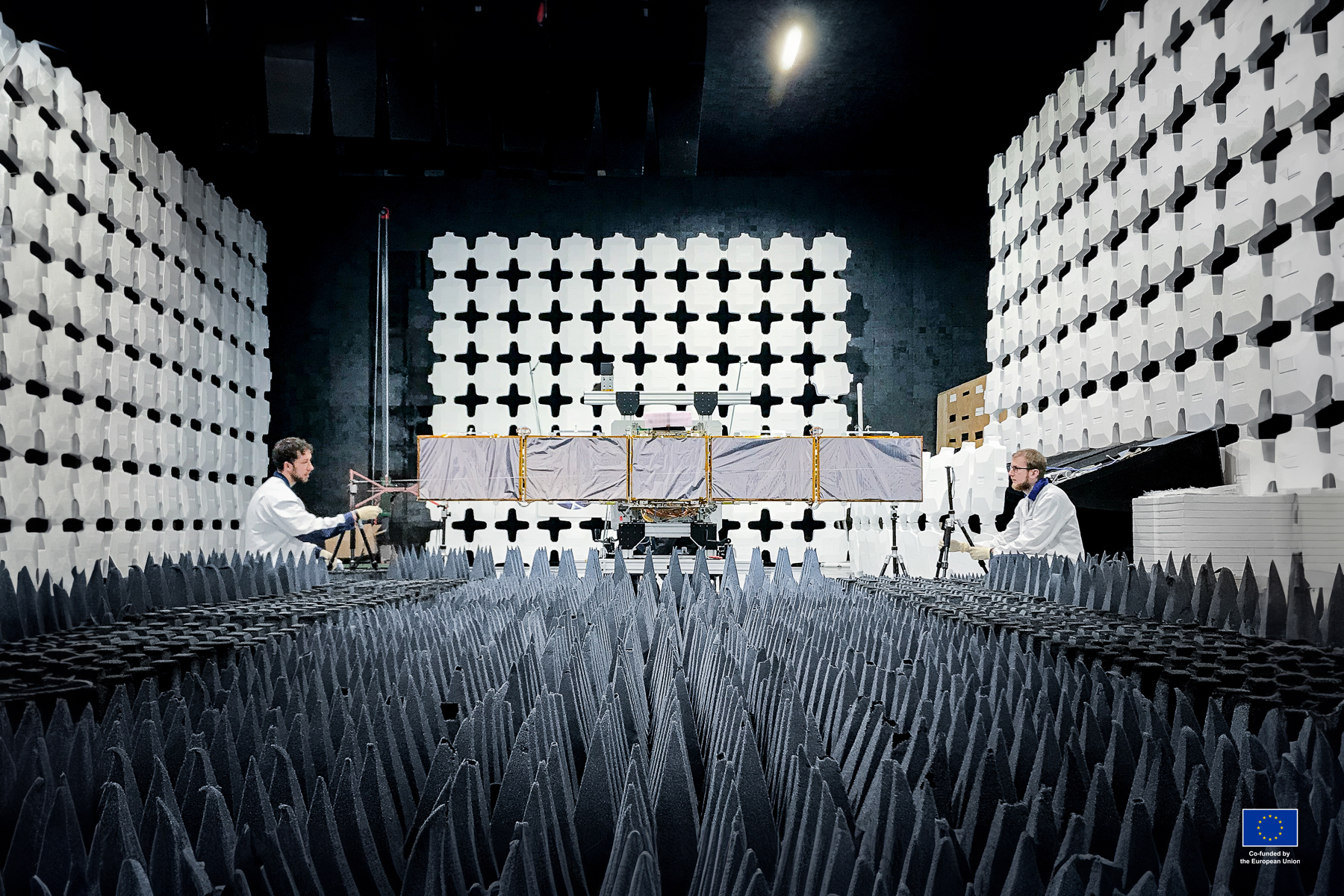
Finland’s state innovation agency Business Finland has approved a €28.3 million grant to satellite company ICEYE, the final instalment of a larger R&D programme whose first tranche was agreed in June 2025 as part of a broader investment plan exceeding €250 million, the company announced on 1 June.
ICEYE, headquartered in Espoo and founded in 2014, operates the world’s largest commercial constellation of synthetic aperture radar (SAR) satellites — spacecraft that can image the Earth’s surface at high resolution through cloud cover, smoke and darkness, unlike conventional optical satellites. The company employs more than 1,000 people across ten countries.
What the money funds
The grant will support advances in ICEYE’s sensing capabilities, data collection, and artificial intelligence-driven analysis, the company said. ICEYE is also working with European command-and-control system integrators on multi-source data fusion — the combining of imagery and signals from multiple satellite and sensor systems into a single intelligence picture.
Pekka Laurila, co-founder and chief strategy officer at ICEYE, said Business Finland’s continued support reflected the progress achieved in the R&D programme’s first phase. “Business Finland’s continued support reflects ICEYE’s strong execution and the progress achieved under the R&D programme. Together, we are strengthening Finnish expertise, scaling domestic R&D, and accelerating technologies that enhance national resilience, situational awareness and sovereign capabilities,” he said.
Lassi Noponen, director general at Business Finland, confirmed that the earlier phase targets had been met before the continuation funding was released. “Business Finland supports ambitious risk-taking and shares the risk — funding is often provided in stages. The results of the first phase of ICEYE’s large project have been achieved, and it is great to be able to move forward with the continuation funding,” he said.
Production at scale
ICEYE has successfully launched 72 satellites since 2018 and recently reached a production rate of one satellite per week. The company is targeting an annual production capacity of 100 satellites by 2028, with 25 launches planned in 2026 and more than 50 in 2027.
Its SAR satellites deliver imagery with a resolution of up to 16 centimetres and a high-resolution field of regard extending to 400 kilometres. SAR technology uses microwave pulses rather than visible light, allowing it to operate through adverse conditions that would render optical satellites ineffective.
The grant announcement follows a separately secured €300 million revolving credit facility, announced earlier this year, which further expands the company’s financial resources as it scales manufacturing.
Defence demand drives investment
The funding arrives as European governments accelerate spending on space-based intelligence capabilities, following years of heightened concern about regional security. ICEYE’s products are used across defence and intelligence, environmental monitoring, insurance and emergency management.
ICEYE has raised approximately $730 million in total equity funding, reaching a valuation of $2.8 billion as of its December 2025 Series E round, according to Tech Funding News. The same outlet reports that the company may be seeking a further €250 million in fresh capital at a valuation that could reach €5 billion, though ICEYE has not confirmed those figures.
Finnish startups captured 85% of all Nordic funding directed towards defence and dual-use technologies in 2025, totalling $410 million, reflecting the country’s growing role in European security technology.
Questions of ownership
The scale of ICEYE’s ambition sits alongside a question familiar to Finnish technology success stories: who ultimately controls the companies that benefit from public investment. ICEYE is already largely American-owned, according to earlier reporting by Kauppalehti, the Finnish business newspaper.
If the company pursues a major US fundraising round or a future listing, its governance structure, strategic direction and tax base could follow the path of other Finnish technology companies that have completed the journey from Nordic startup to American-registered firm.
The €28.3 million Business Finland grant does not address this question. It reflects confidence in ICEYE’s technical execution. Whether the Finnish state’s investment in sovereign space intelligence ultimately serves Finnish strategic interests — or strengthens a company that may be headquartered elsewhere within a few years — will depend on decisions yet to be made.