

AI Already Manages Half of Finland's Knowledge Workers, New Book Finds
Haaga-Helia’s “AI as a Boss” shows algorithmic management has moved from concept to daily reality — and that managers trust the machines more than expected.
Text by Martti Asikainen, 20.8.2026 | Photo by Adobe Stock Photos
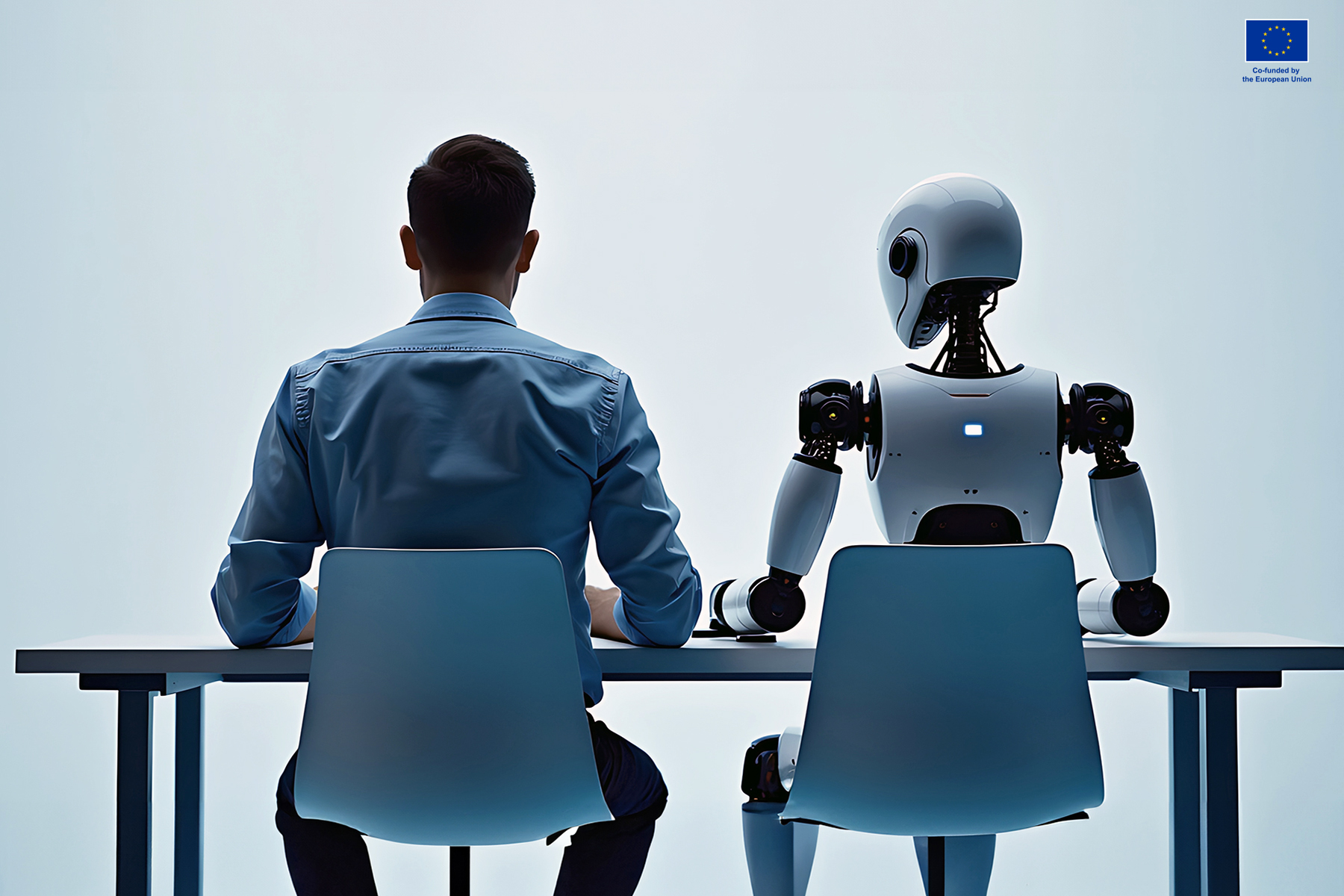
Algorithms already guide roughly every second expert worker in Finland, and their managers trust these systems more than one might assume.
A new book from Haaga-Helia University of Applied Sciences, AI as a Boss: The Role of AI in the Management of Expert and Knowledge-Intensive Work, offers the first research-based map of how deeply algorithmic management has embedded itself in Finnish working life — and what the workforce actually thinks about it.
According to the book, 49% of Finnish knowledge and expert workers have already encountered a situation where an AI system, rather than a person, assigned them a task, evaluated their performance, or gave them feedback.
The trend is even more pronounced internationally. OECD research puts algorithmic management systems in use at 90% of American companies and 79% of European organizations. Those figures measure adoption at the organizational level, however, while the Finnish figure captures something more granular: how many individual employees have personally experienced the phenomenon in their own work.
Managers trust the machine more than you'd think
The book draws on a survey of 323 Finnish managers and supervisors, and the results are striking. Seventy-four percent already use AI-based tools at least weekly, and for routine, data-driven decisions — contract approvals, for example — managers said they defer to a machine’s recommendation over their own judgment 55% of the time, on average.
“We knew algorithmic management had become more common in workplaces, but its scale surprised us too,” says Anna Lahtinen, senior researcher and head of the Machine as Manager project. “One of the most interesting findings concerned the potential linked to leadership tasks.”
Perhaps the most striking finding: 58% of managers believe a machine could actually be a fairer manager than a human, since it makes decisions purely on data rather than personal relationships or moods. Trust in that fairness has a condition attached, though — transparency is non-negotiable.
Eighty-three percent of managers said they would rather work with a transparent AI that is right 75% of the time than an unexplainable “black box” that’s right 95% of the time.
A new lens on expert work
The book was written by a team of Haaga-Helia researchers and experts: Anna Lahtinen, Aarni Tuomi, Janne Kauttonen, Johanna Vuori, and Martti Asikainen. They call the phenomenon “AI as a boss” — the partial or complete transfer of decision-making and management tasks to automated systems, digital tools, or AI.
In the book’s foreword, Sami Masala, founder and CEO of AIThink, frames the shift not as humans versus machines, but as a question of how new tools can extend what people are already capable of at work.
That framing marks a departure from most prior research on the subject, which has focused heavily on the platform economy — food couriers, drivers, gig work. AI as a Boss instead turns to a far less studied context: expert work that depends on judgment, creativity, and human interaction.
The findings are based on a two-year (2025–2026) mixed-methods research project involving more than 1,700 knowledge and expert workers and 323 managers and supervisors, supplemented by a management-focused Delphi future panel and five workshops conducted inside companies.
Roots, flowers, and thorns
The book organizes its findings around the metaphor of a rose. The roots — values, trust, competence, and data — form the foundation without which any lasting benefit is impossible. The flowers are the visible upside: efficiency gains and fairer allocation of resources. The thorns are the risks: eroding trust and murky lines of accountability.
Niklas Bergström, deputy director for HR at Kesko, argues in the book that conversations about algorithmic management too often tilt toward risk alone. Benefits and risks, he says, need to be weighed side by side if organizations want choices that are useful, workable, and responsible all at once.
Building on that balance, the book lays out 14 concrete recommendations for workplaces. One is a “principle of least privilege” for data use: an AI system should only ever access the data and functions strictly necessary for the specific management task it’s performing.
Another insists that the hardest human moments — motivating a struggling employee, defusing a conflict — stay in human hands, even when an algorithm is perfectly capable of flagging that the moment has arrived.
AI as a Boss is aimed primarily at supervisors, HR professionals, and senior leaders overseeing AI adoption, but it offers plenty for knowledge workers and other experts navigating the shift from the other side of the desk.
The book is available free of charge. Download it in full, or read individual sections, on Haaga-Helia’s website.