

Technology has overtaken skill: no one wants prompt training any more
Until recently, organisations wanted to learn how to write the perfect prompt. Today’s advanced AI models understand a task without precise wording, and the questions raised in training sessions have changed: how do we fit AI into our work, and how far can we trust what it tells us?
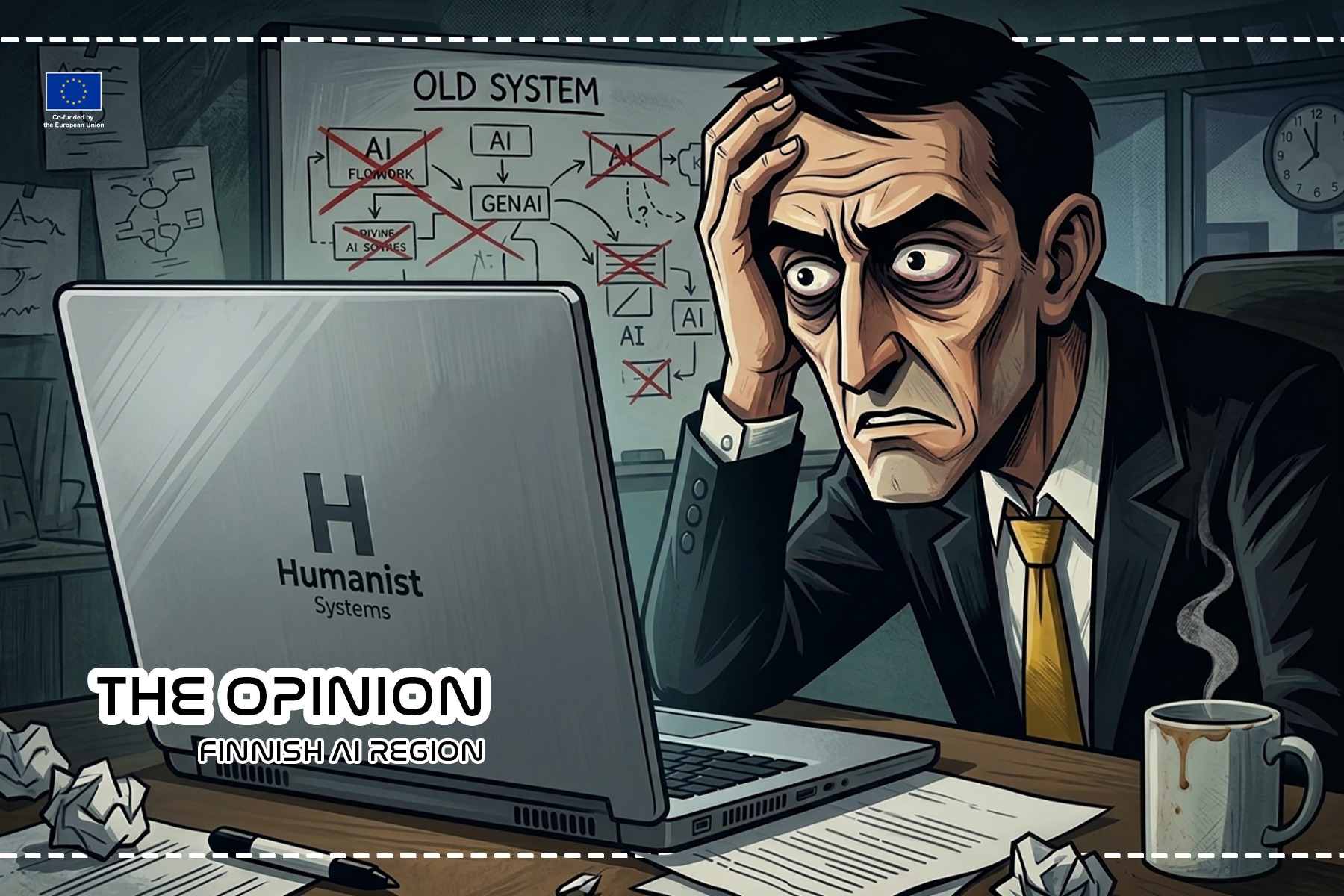
Martti Asikainen | 13.10.2026 | Photo created with AI
In recent years, expert organisations, the public sector and small and medium-sized enterprises (SMEs) all wanted the same thing: they wanted their staff to learn how to write prompts that would get the most out of artificial intelligence. As an AI trainer, I have run workshops of this kind for nearly 200 people across a range of organisations and sectors.
Over the course of this year, however, the situation has changed considerably. I have noticed that prompt training is being requested less and less often, while the wider conversation about AI has moved on to more complex questions. Rather than asking about prompts, people want to know how AI can be built into work processes, how its use should be guided and monitored, and how far the information it produces can be trusted.
Both AI systems and the ways we use them have changed. Technology has overtaken skill, in the sense that even a less accomplished prompt writer can now get the most out of these models simply by using their imagination and knowing what they want.
The prompt was never really the question
When people came to a prompting workshop, it was not really prompts they wanted to learn about. They wanted to know how to get good answers out of AI. Writing prompts was a sound and very human answer to that question at a time when a model’s performance could be steered substantially by how a task was described and what examples it was given.
In the GPT-3 study, Brown et al. (2020) showed that a language model could carry out new tasks from natural-language instructions and a handful of examples, without any task-specific fine-tuning. Wei et al. (2022), for their part, showed that chain-of-thought prompting – guiding the model through intermediate reasoning steps – improved performance on a number of multi-step reasoning tasks. Prompting, then, was not merely a passing consultancy fad but a genuinely useful way of improving what models could do.
Writing a prompt meant specifying a role, a goal, a format, a tone and constraints. Frameworks and templates were useful because they forced you to think about what you actually wanted. Above all, though, they were only ever a means, never an end. The difference is also visible in research. Ma et al. (2024), for example, analysed 10,538 real user prompts collected from a variety of platforms and found that prompts used in practice differ from the carefully designed prompts used in research.
Explicitly specifying a role produced only a marginal improvement with GPT-4, whereas some less common prompt components, such as specifying capabilities and providing examples, could improve responses. The study is a reminder that a prompt optimised in the laboratory and the way people actually use AI are not always the same thing.
Technology overtook skill
Then the technology developed faster than we could learn. The very latest AI models can handle far longer contexts and make use of more complex instructions than before. This does not mean that long contexts are free of problems: research has found that a model’s ability to use information can deteriorate when the relevant information sits in the middle of a long input (Liu et al. 2024).
At the same time, models have made enormous strides in reasoning and in understanding tasks. Wang et al. (2026) found, in software development tasks, that the benefits of prompting techniques developed for earlier models were often smaller with advanced models. In some tasks, complex prompts even reduced performance, and with reasoning models a simple zero-shot prompt could work better.
This still does not mean that ‘prompt engineering’ has disappeared. On the contrary, task-specific instructions and reliable feedback remained useful in the study. But the precise wording of a prompt was no longer as decisive in itself as it had been (Wang et al. 2026). It follows that the importance of the perfect prompt has diminished, at least in some use cases – something worth bearing in mind both in our own work and in teaching.
A conversation can often be a more effective way of working than a single carefully tuned instruction. If the first answer misses the mark, you can steer, add to and correct it in your next message. Prompts do still have their place. When AI is used for a recurring task, for automation or as a shared tool within an organisation, a carefully constructed prompt can be extremely valuable. In ordinary everyday use, however, its role has become smaller, if it has not disappeared altogether.
The time was not wasted
It would be easy to conclude that the time spent on prompt training was wasted. I do not believe that myself. Practising prompts taught us something more lasting than individual techniques: it gave us a feel for how these systems work. We now know why a model needs context, why a vague brief can produce a vague answer, and why a fluent answer from AI does not mean that it is correct.
In my experience, people learn best when they have something concrete to get hold of. In my training sessions, this meant, for example, that participants could apply what they had learned directly to their own work. The prompt was exactly that kind of thing. It made an abstract technology comprehensible and gave people their first experience of how to work with the machine.
When I get good results from AI quickly these days, it is not because I follow a particular template. It is because I have a better understanding of what to tell the model, what to expect from it and what to check in its answer. That understanding grew, at least in part, during the years when prompts had to be written carefully and deliberately.
The most important skill is evaluating the answer
If writing prompts is no longer the only key skill, what is? The ability to evaluate the answer. AI can produce fluent, convincing and well-structured text even when the content is wrong. Research on hallucinations has repeatedly shown that language models can generate false or unfounded claims.
Farquhar et al. (2024) showed that hallucinations in language-model responses can be detected by measuring uncertainty, but the study also confirms the underlying problem: models produce plausible-sounding answers that may not correspond to reality.
In the more recent HALoGEN study, nearly 150,000 responses generated by 14 different language models were evaluated. The researchers found hallucinations in every model studied, and their frequency varied considerably by task and domain (Ravichander et al. 2025).
This is precisely why the fluency of AI-generated text is a poor measure of its reliability. It falls to the expert to judge whether the information produced is accurate, what may be missing from the answer, and whether AI is suited to the task at all. What matters, then, is not simply getting an answer from AI, but understanding when it can be trusted, when it needs to be checked, and when the final responsibility still rests with a human being.
These are not technical skills but the core of expertise – qualities such as judgement and critical evaluation of sources, which have always been needed in demanding work. As AI becomes more widespread, their importance will not diminish.
Recent research on the critical use of generative AI supports this view. The Critical Thinking in AI Use Scale, developed and validated in the study, breaks critical AI use down into dimensions that include verification, epistemic motivation and reflective evaluation. Critical AI use also predicted performance in an AI-assisted fact-checking task (Lau et al. 2026).
What should we be teaching now?
Organisations would do well to broaden the focus of their AI training from prompting techniques to how AI is used as part of work and how the information it produces is evaluated. Good training no longer asks only how to write the perfect prompt. It also asks how to recognise a good answer, how to tell when it is wrong, and when AI should not have been asked in the first place.
This does not mean that prompting can be forgotten. A good brief, sufficient context and well-chosen examples are still useful. But they are only one part of a larger whole. Just as important is what happens after the answer: how claims are checked, how missing information is identified, and how to judge whether the model’s answer is adequate for the task in hand.
At the same time, it must be clear where human responsibility lies. AI can help produce text, suggest solutions and structure information, but responsibility for using its output does not automatically pass to the machine. Perhaps this is the real lesson of prompt training. Prompting workshops were one stage in how we learned to use a new technology. They taught us that we need to know how to give AI a task, context and a goal. Now we need to learn that using AI does not end when it gives us an answer to our question.
Author

Martti Asikainen
Communications Lead, Trainer
Finnish AI Region
martti.asikainen@haaga-helia.fi
This article is part of FinEstAI (Equipping knowledge workers in support functions with AI skills in Finland and Estonia), a project run by Haaga-Helia University of Applied Sciences and Estonian Business School. The project provides training in the use of AI applications for women over 50 in Finland and Estonia, and is funded by the EU’s Interreg Central Baltic programme. The article was originally published in eSignals Pro.
References
Brown, T. B., Mann, B., Ryder, N., Subbiah, M., Kaplan, J. D., Dhariwal, P., Neelakantan, A., Shyam, P., Sastry, G., Askell, A., Agarwal, S., Herbert-Voss, A., Krueger, G., Henighan, T., Child, R., Ramesh, A., Ziegler, D. M., Wu, J., Winter, C., Hesse, C., Chen, M., Sigler, E., Litwin, M., Gray, S., Chess, B., Clark, J., Berner, C., McCandlish, S., Radford, A., Sutskever, I., & Amodei, D. 2020. Language models are few-shot learners. Advances in Neural Information Processing Systems, 33.
Farquhar, S., Kossen, J., Kuhn, L., & Gal, Y. 2024. Detecting hallucinations in large language models using semantic entropy. Nature, 630, 625–630.
Lau, G. R., Low, W. Y., Tay, L., Guevarra, Y. A., Gašević, D., & Hartanto, A. 2026. Understanding critical thinking in generative artificial intelligence use: Development, validation, and correlates of the critical thinking in AI use scale. Computers in Human Behavior Reports, 22, 101103.
Liu, N. F., Lin, K., Hewitt, J., Paranjape, A., Bevilacqua, M., Petroni, F., & Liang, P. 2024. Lost in the middle: How language models use long contexts. Transactions of the Association for Computational Linguistics, 12, 157–173.
Ma, Y., Shen, X., Wu, Y., Zhang, B., Backes, M., & Zhang, Y. 2024. The death and life of great prompts: Analyzing the evolution of LLM prompts from the structural perspective. In Proceedings of the 2024 Conference on Empirical Methods in Natural Language Processing (pp. 21990–22001). Association for Computational Linguistics.
Ravichander, A., Ghela, S., Wadden, D., & Choi, Y. 2025. HALoGEN: Fantastic LLM hallucinations and where to find them. In Proceedings of the 63rd Annual Meeting of the Association for Computational Linguistics (Volume 1: Long Papers) (pp. 1402–1425). Association for Computational Linguistics.
Wang, G., Sun, Z., Ye, S., Gong, Z., Chen, Y., Zhao, Y., Liang, Q., & Hao, D. 2026. Do advanced language models eliminate the need for prompt engineering in software engineering? ACM Transactions on Software Engineering and Methodology, 35(8), Article 243, 1–33.
Wei, J., Wang, X., Schuurmans, D., Bosma, M., Ichter, B., Xia, F., Chi, E., Le, Q. V., & Zhou, D. 2022. Chain-of-thought prompting elicits reasoning in large language models. Advances in Neural Information Processing Systems, 35, 24824–24837.
The author used AI to assist with background research and language editing.