

Europe has built an AI support network, but businesses cannot find the way in
Businesses can access AI expertise, proof-of-concept studies, computing resources, testing and training either free of charge or at subsidised rates. These services already exist, but they are spread across so many different programmes and acronyms that many businesses struggle to find them. The first step, therefore, is not to choose the right service, but to define the business problem that needs solving.
Teemu Moilanen & Martti Asikainen | 16.1.2026 | Photo by Adobe Stock Photos

Finnish small and medium-sized enterprises (SMEs) have access to more AI support than most realise. An SME or start-up can train its AI model free of charge on the LUMI supercomputer in Kajaani. Experts can help it develop an initial proof of concept, while a more mature solution can be tested in a real factory or hospital before the company commits to a major investment.
These services are not a promise for the future: they are available now. The European Union has built a network through which businesses can access AI experts, computing power, testing environments and training. Yet many businesses do not take advantage of these opportunities. The bottleneck is not a lack of resources, but a failure to connect needs with the services available.
An alphabet soup that hides the services
It would be easy to assume that these services go unused because businesses are not interested. The real reason, however, is how the offering appears from the outside. EDIHs, AI Factories, TEFs, AIoD and regulatory sandboxes have each emerged from separate programmes with their own funding arrangements. To a busy business leader, the result looks much like alphabet soup.
There is a political objective behind this service network. The United States leads private investment in AI by a considerable margin. In 2025, private AI investment there totalled approximately USD 286 billion, compared with around USD 21 billion in Europe and USD 12 billion in China. The Chinese figure excludes state-directed funding, and China has already almost caught up with the United States in AI model performance (Sajadieh et al., 2026).
The European Union wants to strengthen its own AI capabilities and technological sovereignty in the face of competition from these two powers. The AI Continent Action Plan, published in April 2025, sets out five priorities: computing infrastructure, data, skills, AI development and adoption, and implementation of the AI Act (European Commission, 2025a). The Apply AI Strategy, published in October of the same year, specifies how adoption will be accelerated in ten strategic sectors and the public sector (European Commission, 2025b).
Strategies, however, merely establish the framework. Competitiveness is determined by businesses that adopt AI and turn it into measurable commercial value. Buying an off-the-shelf tool is not enough, because a competitor can buy exactly the same tool tomorrow. A distinctive advantage comes from what a business builds around its own processes, data and problems (Khan, 2026). The most interesting question, therefore, is not what has been decided in Brussels, but what a business can do with those decisions when it arrives at the office on Monday morning.
From an idea to a working proof of concept
The EU’s AI infrastructure is not a single service, but a set of complementary organisations and facilities that help businesses develop, test, scale up and deploy AI (European Commission, n.d.-a; European Union, 2025). Many services are free of charge or heavily subsidised because the EU and national funding bodies cover some or even all of their costs. It all sounds rather complicated. The easiest way to understand the system is to follow a business’s journey from an initial idea to a finished solution.
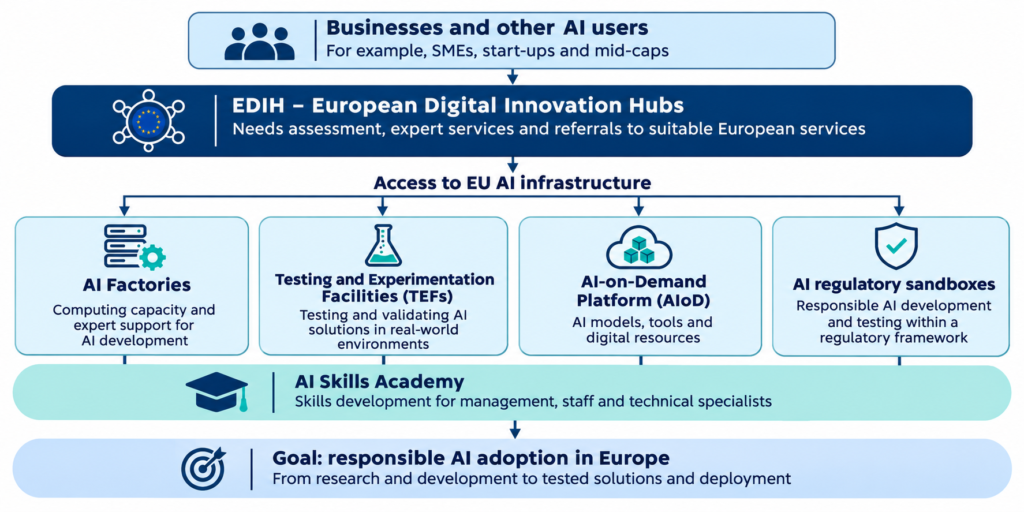
The journey usually begins at a point of entry called a European Digital Innovation Hub (EDIH). It acts as an impartial expert partner, with most of the bill paid by someone else. Specialists in business and technology are brought together from universities, research institutes and partner companies to address the business’s particular needs. They help with strategy, selecting use cases, technical planning and funding applications. If an EDIH cannot provide a particular service itself, it directs the business to the appropriate provider in Finland or elsewhere in Europe.
There are more than 200 EDIHs across Europe. In Finland, the EDIH specialising in AI is Finnish AI Region (FAIR). Its guiding principle is test before invest. In practice, this often means carrying out a proof of concept (PoC). A PoC is not a prototype, but a limited test of whether the central assumption behind an idea holds true. The answer might be yes, not yet or no. Each outcome has value, because an inexpensive test may save a business from a much costlier failed investment (Asikainen & Khan, 2026). The business also learns what deployment would require within its own systems. FAIR offers PoC services free of charge to SMEs, mid-cap companies and public-sector organisations.
If the experiment requires more computing power than the business has available, the next stop is the engine room. An AI Factory may sound like a manufacturing plant, but for a business it is primarily a service environment that brings together computing resources, data services, experts and training around a supercomputer. It enables businesses to train and fine-tune models and process large datasets. There are 19 AI Factories across Europe, offering free, tailored support to SMEs and start-ups.
Finland’s LUMI AI Factory is built around the LUMI supercomputer in Kajaani. Start-ups, SMEs, research organisations and public-sector bodies can access computing capacity, training and expert assistance free of charge. For businesses, free access applies to innovation activities; large companies and other industrial uses are charged (LUMI, n.d.). LUMI-AI, scheduled to enter service in 2027, is expected to increase LUMI’s AI capacity by up to a factor of ten (EuroHPC JU, 2026). This gives even a small business the opportunity to develop solutions using computing resources comparable to those available to Europe’s leading research institutes.
From experimentation to deployment
A solution that works in a laboratory will not necessarily work in a hospital or factory. This is why the EU has established what might be called AI test tracks: Testing and Experimentation Facilities (TEFs). These enable mature AI solutions to be tested in real-world or realistic conditions. The EU’s four sector-specific TEFs cover healthcare, manufacturing, agri-food, and smart cities and communities (European Commission, n.d.-b). Through TEF-Health, for example, a solution can be tested in clinical and care settings (TEF-Health, n.d.). Unlike many other services in the network, TEF services are not free, although SMEs can access them at reduced rates.
Once a product is ready, it needs visibility. The AI-on-Demand Platform (AIoD) brings European AI resources together in one place. Its Business Navigator helps users find organisations, service providers and partners, while its Marketplace showcases products, services, tools and infrastructure (AI-on-Demand Platform, n.d.). For a company supplying AI solutions, the platform serves as a shop window to potential customers across Europe. In Finland, FAIR acts as AIoD’s national partner and reviews the profiles that Finnish service providers submit to the Business Navigator.
Along the way, the business must also establish which regulatory requirements apply to its product. An AI regulatory sandbox offers support with this. It is a controlled environment in which an AI system can be developed and tested under the supervision of a competent authority before being placed on the market. The idea is somewhat like discussing a proposed arrangement with the tax authorities in advance: requirements and potential issues can be clarified together before proceeding. This helps the business understand which rules apply to its product and which risk category it falls into. In Finland, AI regulatory sandboxes are the responsibility of the Finnish Transport and Communications Agency Traficom. The pilot phase is under way, and the full service is scheduled to begin on 3 May 2027 (Traficom, n.d.). Under the AI Act, participation is generally free of charge for SMEs and start-ups (Regulation (EU) 2024/1689).
Skills are also needed throughout the journey. Management must be able to assess the benefits and risks; users must recognise the limitations of a solution; and technical staff must be able to integrate and maintain it. The European AI Skills Academy, launched in June 2026, brings together training particularly in generative AI. EDIHs and AI Factories also offer courses. In practice, however, skills are developed most effectively as part of a real project rather than through a separate day of training.
Free of charge does not mean effortless
So far, the story sounds straightforward: help is available free of charge, so businesses should make use of it. The reality is more complicated. A free service is not cost-free for the business, because it still requires staff time, data and decisions. Someone must define the problem, prepare the data and keep the work moving.
For example, FAIR’s needs assessment involves at least two representatives from the business alongside two experts. Ideally, one of the business representatives should have technical knowledge. In a small, owner-managed business, such a person is not always available. Before the first meeting, it therefore makes sense to appoint someone to take responsibility for the project, establish where the data is held and who controls it, and allocate staff time to the experiment.
Nor are the terms the same for everyone. Eligibility and conditions of use vary between services. The value of a free or discounted service is generally treated as State aid, most often under the de minimis aid rules. It does not have to be repaid, but it counts towards the same aid ceiling as support received from other public funding bodies. Businesses should therefore keep records of any aid received and tell the service provider if they are applying for other public funding at the same time. These services complement grants and funding calls; they do not replace them.
Responsibility does not pass to the service provider. Participation in an AI regulatory sandbox is neither a conformity assessment nor certification, and the business remains responsible for ensuring that its solution complies with the applicable requirements. A regulatory sandbox should also be distinguished from FAIR’s regulatory advisory services. FAIR’s one-hour readiness consultation covers obligations under the AI Act and assesses the likely risk classification of an AI system. Decisions about admission to and supervision of a regulatory sandbox, however, rest with the competent authority. Not every regulatory question requires a sandbox.
Perhaps the most important point is that these services are not a product catalogue from which a business simply selects the option that looks most suitable at the time. Their value lies in combining them, and the right combination depends on the challenge the business is trying to solve.
A professional services firm wanting to speed up information retrieval could define a use case with an EDIH and, in a PoC, compare an AI assistant’s answers with its existing way of working. The outcome would be evidence to support a decision, rather than just a demonstration.
A manufacturing company exploring computer vision could define its data requirements with an EDIH, train its model at the LUMI AI Factory and test the solution under production-like conditions at a manufacturing TEF. It is worth agreeing the performance metrics in advance. In addition to accuracy, the company should monitor the number of false alarms and how well the solution fits into the production process: a system that is too sensitive will stop the line unnecessarily, while one that is too permissive will allow defects through.
A health technology company, meanwhile, could obtain evidence of its solution’s performance through TEF-Health and support in interpreting regulatory requirements through a sandbox. Because testing and regulatory guidance address different questions, they should be planned together. That way, the test evidence can also support the regulatory documentation, avoiding the need to generate the same results twice.
Why is it worth conducting a PoC carefully? One company supported by FAIR offers an answer. It wanted to convert customers’ purchase orders automatically into sales orders in its own system. The task sounded straightforward, but in practice the solution had to extract product information from documents in widely varying formats, price individual line items traceably against a price list, and reproduce the judgement employees use when information is missing or contradictory (Khan, 2026).
These are exactly the kinds of surprises that an experiment is meant to uncover early, before the business has committed to an implementation whose complexity it did not fully understand. This case and all the previous examples have one thing in common, and it is not the technology. It is the question worth asking at the outset: what exactly do we want to know before we invest?
Start with the problem, not the service
A business does not need to know the EU’s entire service network. It needs to understand its own problem; navigating the network is the EDIHs’ job. FAIR does this in the fields of artificial intelligence, extended reality, high-performance computing and cybersecurity, making the expertise of nine organisations available to businesses.
By October 2026, FAIR had delivered nearly 700 advisory, testing and funding-related services to more than 420 business clients, and over 14,500 people had participated in its events. If a business needs a specialised European service, FAIR helps it find the right provider and establish the conditions for accessing it.
There is no need for a detailed technical project plan at the first meeting. It is enough for the business to know what it wants to improve, how the task is currently handled, and whether it already has an idea, data, an experiment or a finished solution. A brief readiness assessment or an initial test of the idea through a dissertation project, student project or PoC may be sufficient. A business should commit to a larger project only after the initial experiment has produced promising evidence.
Businesses can contact FAIR through its website. Its AI Helpdesk answers questions about AI, regulation and finding an appropriate service
Authors

Teemu Moilanen
Manager
Finnish AI Region
teemu.moilanen@haaga-helia.fi

Martti Asikainen
Communications Lead
Finnish AI Region
martti.asikainen@haaga-helia.fi
References
AI-on-Demand Platform. (n.d.). AI-on-Demand Platform. Accessed 8 October 2026. https://www.ai4europe.eu/
Asikainen, M., & Khan, U. A. (2026, 12 October). PoC on halvin tapa olla väärässä – miksi idea kannattaa todentaa ennen kuin siihen investoi. Finnish AI Region. https://www.fairedih.fi/2026/10/12/poc-on-halvin-tapa-olla-vaarassa-miksi-idea-kannattaa-todentaa-ennen-kuin-siihen-investoi/
Asikainen, M., & Moilanen, T. (2026). Porttisi Euroopan tekoälypalveluihin: Euroopan unionin tekoälyinfrastruktuuri. Finnish AI Region. https://www.fairedih.fi
EuroHPC JU. (2026, 31 August). EuroHPC JU signs contract to deploy the LUMI-AI supercomputer. https://www.eurohpc-ju.europa.eu/eurohpc-ju-signs-contract-deploy-lumi-ai-supercomputer-2026-08-31_en
Euroopan komissio. (n.d.-a). Ecosystem for AI innovation in Europe. Shaping Europe’s digital future. Accessed 8 October 2026. https://digital-strategy.ec.europa.eu/en/policies/ecosystem-ai-innovation-europe
Euroopan komissio. (n.d.-b). Sectorial AI testing and experimentation facilities under the Digital Europe Programme. Shaping Europe’s digital future. Accessed 12 November 2026. https://digital-strategy.ec.europa.eu/en/policies/testing-and-experimentation-facilities
Euroopan komissio. (2025a, 9 April). AI Continent Action Plan (COM(2025) 165 final). Shaping Europe’s digital future. https://digital-strategy.ec.europa.eu/en/library/ai-continent-action-plan
Euroopan komissio. (2025b, 8 October). Apply AI Strategy (COM(2025) 723 final). Shaping Europe’s digital future. https://digital-strategy.ec.europa.eu/en/library/apply-ai-strategy
Euroopan parlamentin ja neuvoston asetus (EU) 2024/1689 tekoälyä koskevien yhdenmukaistettujen sääntöjen vahvistamisesta (tekoälysäädös). (2024). Euroopan unionin virallinen lehti, L 2024/1689, 12 July 2024. http://data.europa.eu/eli/reg/2024/1689/oj
Euroopan unioni. (2025). A brief guide about the European AI innovation ecosystem. European Digital Innovation Hubs Network. https://european-digital-innovation-hubs.ec.europa.eu/system/files/2025-07/AI_infrastructure_Leaflet_web_v10.pdf
Khan, U. A. (2026, 22 September). Suomalaiset yritykset ostavat tekoälyä, eivät kehitä sitä. Finnish AI Region. https://www.fairedih.fi/2026/09/22/suomalaiset-yritykset-ostavat-tekoalya-eivat-kehita-sita/
Liikenne- ja viestintävirasto Traficom. (n.d.). Tekoälyn sääntelyn testiympäristö. Accessed 12 November 2026. https://www.traficom.fi/fi/tekoalyn-saantely/tekoalyn-saantelyn-testiymparisto
LUMI. (n.d.). Access calls for AI Factories. Accessed 11 November 2026. https://lumi-supercomputer.eu/access-calls-for-ai-factories/
Sajadieh, S., Fattorini, L., Perrault, R., Gil, Y., Parli, V., Santarlasci, L., Pava, J., Maslej, N. et al. (2026). The AI Index 2026 annual report. AI Index Steering Committee, Stanford Institute for Human-Centered Artificial Intelligence, Stanford University. https://hai.stanford.edu/ai-index/2026-ai-index-report
TEF-Health. (n.d.). About TEF-Health. Accessed 12 November 2026. https://tef.charite.de/about