

Nokia opens AI networking lab in California as legacy tech stocks surge on infrastructure boom
Nokia has launched a dedicated AI networking laboratory in Silicon Valley, betting that surging demand for AI infrastructure will cement the Finnish telecoms firm’s remarkable comeback — its shares have surged over the past year as investors pile into legacy technology stocks riding the AI infrastructure boom.
Text by Martti Asikainen, 5.5.2026 | Photo by Nokia
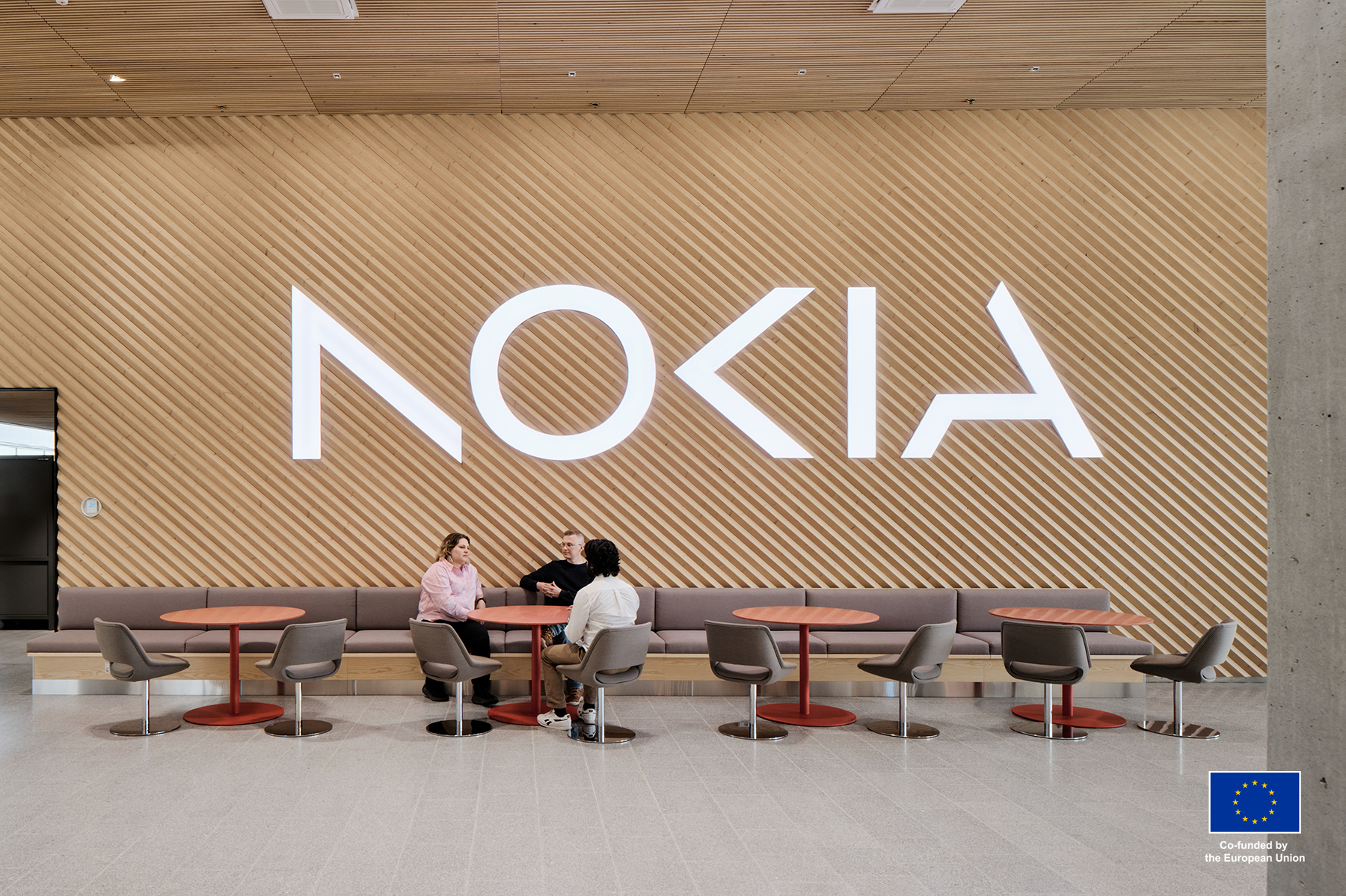
Finnish telecoms firm Nokia has launched a dedicated research facility in Sunnyvale, California, to develop and test data centre networking technology for AI workloads. This move coincides with a broader stock market revaluation of 1990s technology companies as AI infrastructure spending accelerates.
Nokia opened its AI Networking Innovation Lab on 21 May, establishing a co-development facility where the company and a group of early technology partners will design, test, and validate networking architectures built specifically for large-scale AI training and real-time inference. The lab is located at Nokia’s existing Sunnyvale campus in California’s Silicon Valley.
The facility brings together eight initial partners, AMD, Everpure, Keysight, Lenovo, Nscale, Supermicro, VIAVI, and Weka, to work on networking protocols, switching silicon, congestion management, and automation systems tailored to AI data centres, which place substantially higher demands on network infrastructure than conventional cloud computing.
What the lab will do
Nokia describes the lab as operating across three areas. The first is technology development: testing new protocols and hardware approaches, including congestion control and real-time telemetry. The second is ecosystem collaboration: joint testing with silicon manufacturers, GPU developers, and storage vendors to improve interoperability across hardware and software layers. The third is validation: the facility serves as the testing ground for Nokia’s “Validated Designs” — multi-vendor data centre architectures tested against realistic AI workloads, including failure scenarios and congestion behaviour, before deployment.
“This lab is poised to accelerate AI networking technology that will not only support but optimise these emerging industry offerings,” said Rudy Hoebeke, Vice President of Software Product Management at Nokia, in the company’s announcement. He said the aim was to give customers earlier access to new technologies and “the confidence that their networks are validated under more realistic AI conditions.”
Partners offered supportive assessments. Ram Periakaruppan, Vice President and General Manager of the Network Applications and Security business at Keysight, said the collaboration had enabled benchmarking of AI networks under realistic conditions across a range of networking standards. Travis Karr, Corporate Vice President of HPC and Sovereign AI at AMD, said an open, standards-based approach was “fundamental to accelerating AI innovation” and helped customers avoid vendor lock-in.
The wider market context
Nokia’s laboratory investment arrives as the company’s stock has become one of the most prominent beneficiaries of a broader rally in legacy technology firms, according to reporting by Bloomberg. A rush to build out AI infrastructure has led to soaring demand for servers, storage components, networking gear, and even older chip designs, sweeping up iconic technology names from the 1990s, including many of the so-called “Four Horsemen” — companies once considered the era’s equivalent of today’s Magnificent Seven cohort.
Nokia, Dell, and Lenovo, alongside Micron Technology, Intel, Texas Instruments, and Cisco Systems, have collectively gained an average of 158 per cent in 2026, adding a combined $1.7 trillion in market value.
For Nokia specifically, the AI infrastructure wave represents a significant turnaround. The company had a difficult 2024, with revenues declining year on year, and appointed a new chief executive in early 2025 as it repositioned towards AI-related networking markets. Its existing data centre networking portfolio, combined with a partnership announced last year with Nvidia to develop wireless infrastructure for AI applications, has drawn renewed investor attention.