Finland's AI adoption is struggling to become business value, says Dr Umair Ali Khan
Finnish companies are efficient with AI but structurally unprepared to turn that efficiency into revenue, new Nordic data shows — and the reason has little to do with the technology itself.
Text by Martti Asikainen, 13.7.2026 | Photo by Haaga-Helia
Finnish businesses have embraced artificial intelligence faster than almost anywhere else in the Nordic region — but few are turning that adoption into extra revenue, according to researchers who work directly with hundreds of companies on their AI strategies.
The data shows a striking gap: 79% of Nordic organisations say AI has made them more efficient, but only 18% report that this has translated into revenue growth, according to Deloitte’s 2026 State of AI in the Nordics survey, cited in a wider analysis by FAIR researchers.
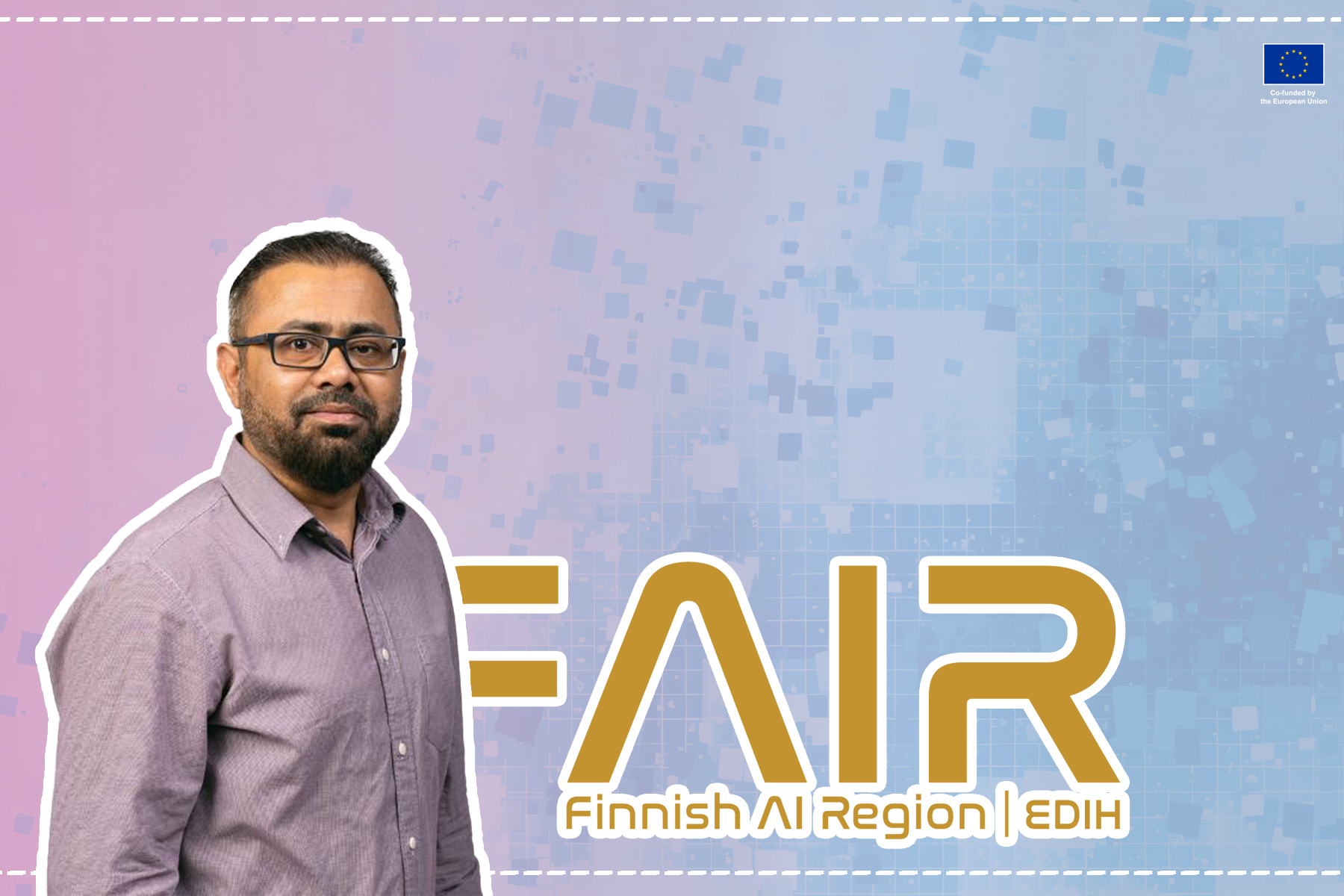
Dr Umair Ali Khan, a senior researcher at Haaga-Helia University of Applied Sciences and the Finnish AI Region, a Finland-based innovation hub backed by the EU, says the pattern shows up constantly in his own consultancy work with local firms.
“No ownership means no measurement,” he said. “No measurement means no scaling.”
Dr Khan argues the problem has little to do with the technology itself. Companies are buying the tools and running pilots successfully — the issue is what happens afterwards.
Gains that don't spread
According to Dr Khan, a typical pattern looks like this: a team adopts an AI tool, automates a task, and saves real time. But the benefit rarely spreads to the rest of the company. Nobody is responsible for checking whether it worked, so nobody scales it up, and the lesson dies with the pilot.
Separate Finnish government data points in the same direction. A Statistics Finland survey published in February found 80% of Finnish workers using AI say it speeds up their work, with an average time saving of five and a half hours a month — a meaningful amount individually, though Dr Khan argues it is still not translating into company-wide gains.
Dr Khan’s identifies one specific gap behind this: only one in five Nordic organisations has appointed anyone accountable for making sure AI actually delivers business results, rather than simply being adopted, the Deloitte survey found.
Companies that do succeed, he says, tend to share three habits: someone is explicitly tasked with tracking business outcomes rather than usage numbers; successful pilots are deliberately pushed out to other teams instead of being left where they started; and passing on what works is treated as part of managers’ jobs, not something that happens by itself.
A shrinking appetite for specialists
The research also points to a shift in how Finnish companies are trying to close their skills gaps — and it isn’t necessarily reassuring. The share of Finnish firms planning to hire a dedicated AI specialist has fallen from 60% to 33% over five years, even as AI use has become more widespread, separate FAIR research from 2025 found.
A wider 2026 survey of 200 Finnish business leaders, carried out by Taloustutkimus for FAIR, found the biggest barriers to further AI adoption were a lack of relevant skills (33%), concerns about data security (29%), and regulatory uncertainty (28%), followed by a lack of time and unclear returns on investment.
That regulatory uncertainty may be more pressing than many firms realise. The survey found only a quarter of companies said they were well acquainted with the EU’s AI Act, even though parts of the law have applied since February 2025. The remaining provisions come into force on 2 August this year.
Missing the research on their doorstep
The researchers also highlight a disconnect between Finland’s strength in AI research and how little of it companies actually draw on. Even among Finnish firms running advanced AI projects, only one in five is working directly with a university or research institute, according to 2026 research by Demos Helsinki.
Companies that do collaborate with researchers are more likely to turn AI experiments into finished products, Dr Khan said — though he cautioned that partnerships alone will not help firms that lack the internal capacity to make use of what they learn.
The Deloitte survey points to a widening mismatch between how much Nordic firms are investing in AI and how ready they feel to use it. Just 5% of organisations plan to increase AI investment this year, while the proportion describing themselves as strategically prepared has fallen from 61% to 43%, and those describing themselves as prepared in terms of talent has dropped from 33% to 14%.
For Dr Khan, the fix is less about buying better tools and more about treating AI as a strategic responsibility with a named owner, rather than something bolted onto existing workflows.
“The tools are not the constraint,” he said. “The system around the tools is.”
You can read the whole analysis written by Dr Khan and Mr Martti Asikainen from here.