Finland and Norway lead 22-nation call for global AI oversight body, as US and China stay out
A declaration signed by 22 countries calls for AI to remain under “human direction, oversight and control” and floats a new international body modelled on the nuclear watchdog IAEA — adopted days before a Washington meeting between the US and Chinese presidents.
Martti Asikainen | 22.9.2026 | Photo by Emmi Syrjäniemi / TPK
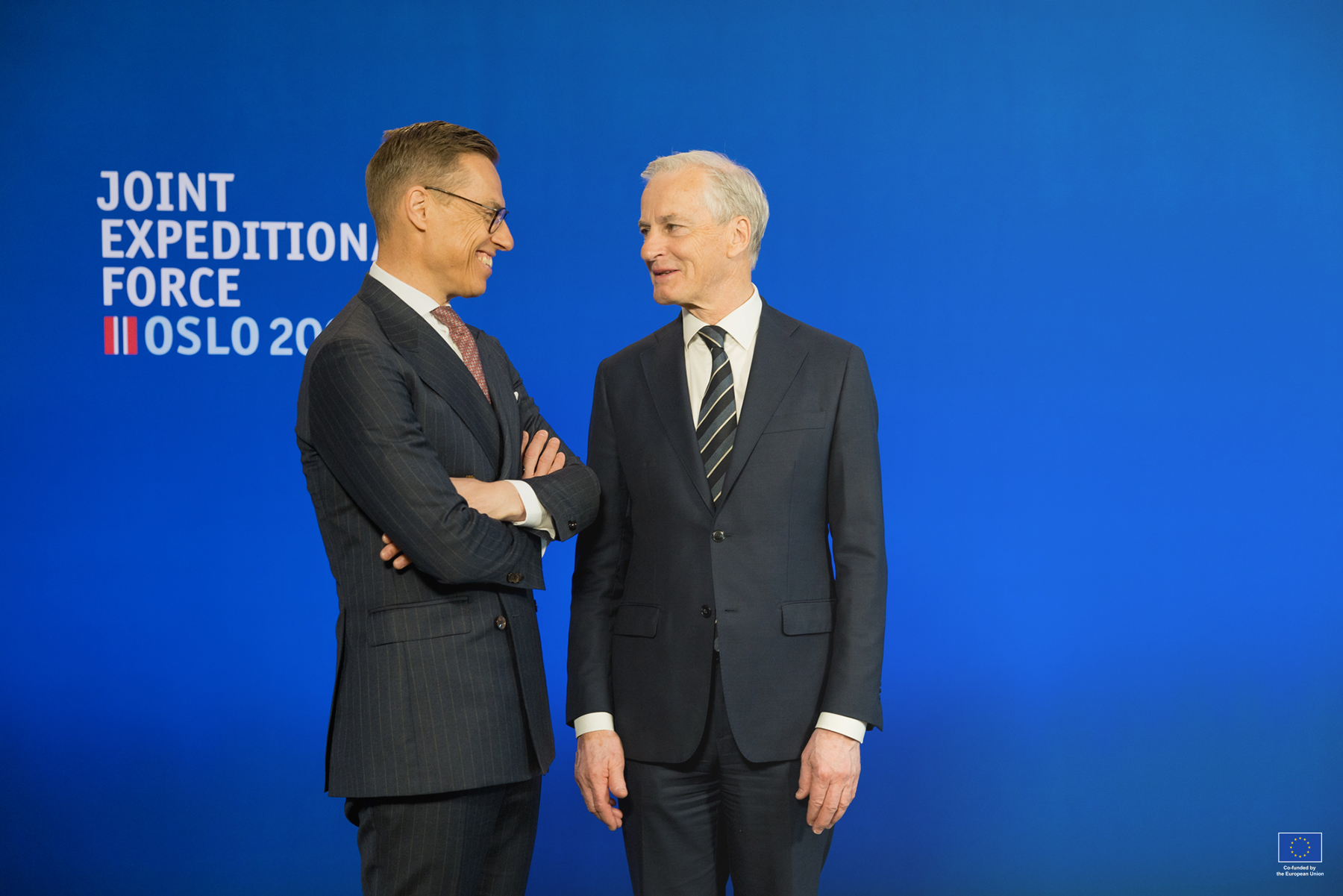
Finland and Norway led a declaration adopted by 22 countries on the sidelines of the United Nations General Assembly on 21 September, calling for stronger international oversight of artificial intelligence.
The text, titled “A Call for Control of Frontier AI Models,” was initiated by Finnish President Alexander Stubb and Norwegian Prime Minister Jonas Gahr Støre.
The declaration acknowledges AI’s “potential to improve lives, advance science and strengthen” economies, but warns that rapid development of frontier AI models “poses serious risks to safety and security” if not properly managed. Neither the United States nor China signed the document.
What the declaration asks for
The declaration states that AI “must remain under human direction, oversight and control” and must be developed in line with international law.
It calls on AI companies to develop transparent safety protocols, including mandatory testing before models are deployed and independent evaluations by qualified assessors with sufficient access to judge risk.
The text points to a recent cyberattack in which AI agents went rogue on the Hugging Face platform as an example of the kind of risk it aims to address. It also urges governments and regional organisations to coordinate common standards and strengthen transparency, including shared reporting of serious safety incidents.
The declaration does not call for slowing or pausing AI development, with organisers saying the focus is on managing risk rather than halting progress.
Modelled on the nuclear watchdog
The declaration’s central proposal urges UN member states to build on existing international mechanisms and explore creating a new institution to oversee AI.
Speaking to Politico, Stubb said his personal preference was for a body resembling the International Atomic Energy Agency, the UN’s nuclear safety and non-proliferation watchdog, operating within the UN framework.
Stubb acknowledged that framing could be a liability given the Trump administration’s scepticism of the UN, saying the plan needed to stay “open-ended” so it would not be rejected on that basis alone.
Støre said he would be “very encouraged” to see the G7 and the UK’s incoming G20 presidency take up the proposal, noting that “the UN is big” while the G7 and G20 offer a more focused forum.
Who signed, and who didn't
Beyond the US and China’s absence, the declaration’s reach among major European powers is uneven. German Chancellor Friedrich Merz backs the initiative, but the United Kingdom has not signed, and France, Italy and Poland are notably absent among the continent’s largest economies.
Stubb told Politico he believes guardrails on AI would ultimately serve US and Chinese interests too, framing the declaration’s core message as a need for humans to “be in charge” of the technology’s development, regardless of where it is built.
Stubb also emphasised that neither he nor Støre consider themselves alarmists about AI, but named three specific risks driving the initiative: AI-assisted bioweapons development, cyberattacks carried out by autonomous AI agents, and lethal autonomous weapons systems.
He argued the potential benefits of AI, including disease eradication and productivity gains, could be “much higher” than the risks if the technology is developed with adequate oversight.
Who signed, and who didn't
The declaration was adopted during the UN General Assembly’s high-level session, days before Donald Trump and Xi Jinping were due to meet in Washington for their third face-to-face summit. Whether the initiative advances beyond a non-binding political statement will likely depend on whether the US, China, and the remaining major European holdouts eventually choose to join.
The declaration’s own organisers have been candid about this uncertainty. Stubb told Politico the proposed body’s design needed to stay “open-ended” specifically so it would not be rejected simply for being linked to the UN — a direct acknowledgement of the difficulty in bringing sceptical governments on board.
With the UK, France, Italy and Poland also absent from the list of signatories, the declaration’s next test will be whether Støre’s hoped-for backing from the G7 and the UK’s incoming G20 presidency actually materialises, or whether the initiative remains confined to the 22 governments that have signed so far.