
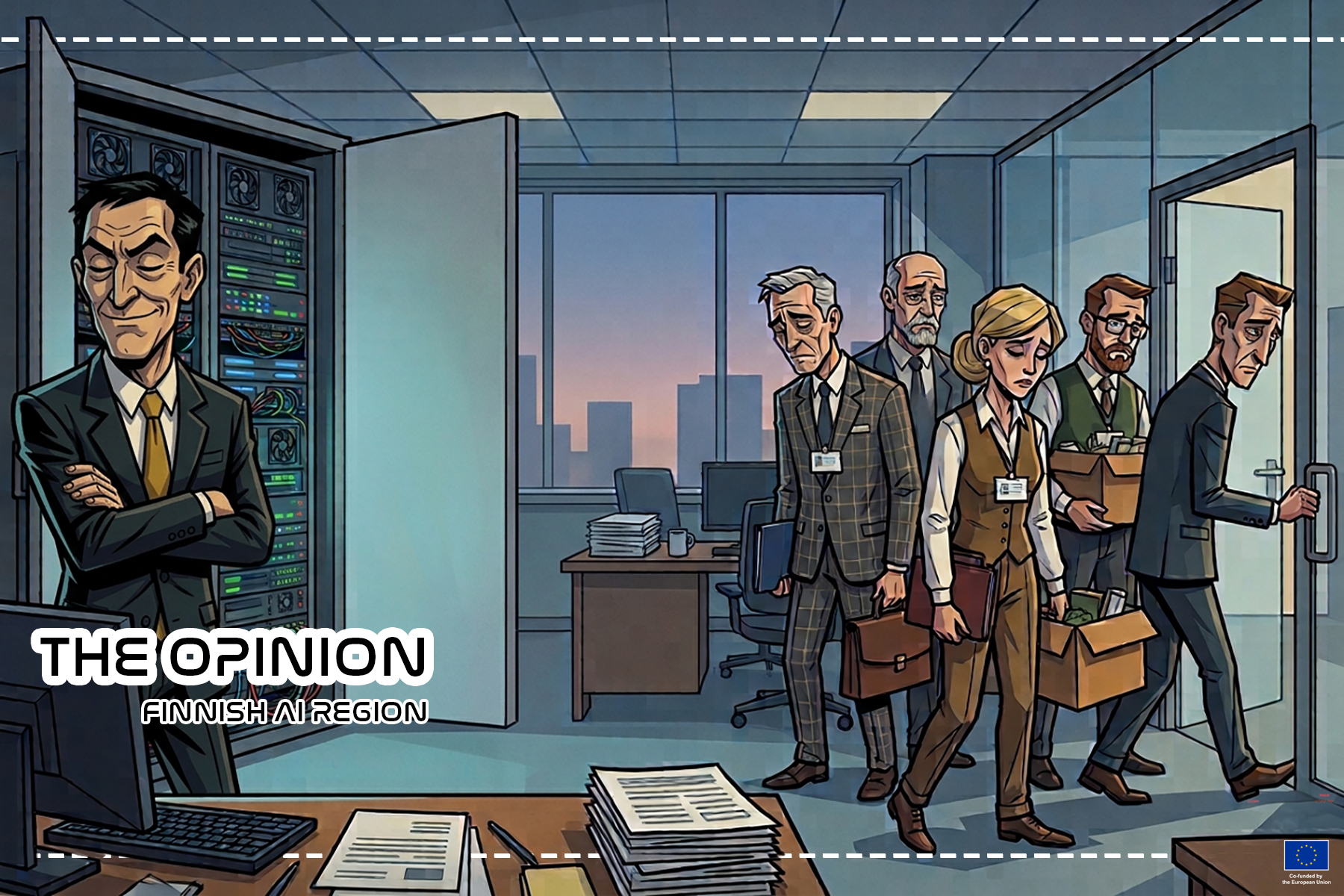
Who holds the organisation together if part of middle management's work passes to algorithms?
It is certain that some middle-management work will be automated. Even so, the need for interpretation does not disappear when the layer that carried it out is removed. Someone must still explain what is happening and why, and when nobody is accountable for that, the work falls to the employees.
Martti Asikainen | 23.11.2026 | Photo generated with AI
According to a national survey carried out by Haaga-Helia University of Applied Sciences in spring 2026, nearly three in five Finnish managers consider it possible that a machine could lead more fairly than a human being (Lahtinen et al., 2026). Yet more than four in five would rather work with an AI that errs once in every four attempts than with one that is almost always right but cannot explain itself (ibid.).
These findings are not at odds with one another. Taken together, they tell us what we expect of leadership: not merely the right decision, but a decision we can understand, discuss and challenge. A machine can deliver consistency, but explaining that consistency is harder for it. Algorithmic management can be fair and cold at the same time (Asikainen, 2026).
This is not merely a matter of theory. In our national survey, 49 per cent of 1,704 Finnish knowledge workers and other professionals had already encountered a situation in which a machine or AI performed a management task, such as allocating work, appraising performance or giving feedback (Lahtinen et al., 2026). In other words, algorithmic management has arrived in the office, and it lands squarely on the layer of the organisation whose job is to explain.
The subject also surfaced recently in Kauppalehti, where Risto Siilasmaa presented a management model in which companies are built entirely around AI. He is testing the model at Atenos, the start-up he founded. According to Siilasmaa, AI strips out middle management’s routine tasks, leaving decision-making as the main human role in knowledge work (Koho, 2026). The premise is sound, but it sees middle management only as a decision-maker. Besides making decisions, middle management also translates, interprets and connects with people.
The cascade that carried the story
For decades, strategy flowed from the top down. The executive team decided, and middle management translated the decision into language people could understand. Middle management was the filter, the interpreter and the engine that turned abstract, lofty goals into Tuesday-afternoon priorities (e.g. Holm et al., 2026; Christie & Tippmann, 2024). An orchestra offers a useful metaphor. Everyone plays from the same sheet music, but every hall sounds different and every evening is different. The conductor listens to both the hall and the players and adjusts the tempo so that the same score sounds right for the occasion.
In management research, this work is described with the concepts of sensemaking, the building of an understanding of what is happening around us, and sensegiving, the shaping of that understanding for others to use. Rouleau’s (2005) classic study showed that middle managers implement strategy above all through this kind of everyday interpretation. They draw on tacit knowledge accumulated at the interfaces where the organisation meets its customers and its own contradictions.
Today, automated dashboards, project tools such as Jira and Asana, and knowledge repositories built on large language models feed data and tasks directly to employees. The result is not merely faster communication but communication without a translator. When an organisation removes the layer whose job was interpretation, the need for interpretation does not go anywhere. Instead, it falls to employees themselves, who either handle it alone and inconsistently or leave it undone altogether. This is not a failure on the part of individual employees but the consequence of a decision taken higher up.
More than a relay
The efficiency argument is easy to understand. The cascade, in which strategy is translated layer by layer, was built for a slow decision-making rhythm, and as the pace quickens every intermediate layer starts to look like latency. A considerable share of middle management’s work is relaying: compiling situational overviews, reporting upwards and passing decisions downwards. This is the routine work whose disappearance Siilasmaa also talks about, and to that extent the claim holds.
The key question, then, is what the word “work” means here. If middle management is seen purely as a relay chain, its work will indeed run out in the near future. If it is seen as an interpretive layer, the work does not run out; it becomes invisible once the layer disappears. Middle management holds the organisation together through interaction and everyday communication, by connecting with people and their human needs. I have yet to see AI do the same in my own work. On the contrary, in a reality coloured by AI, the need for genuine human engagement is greater than ever.
The same distinction appears in the Finnish data. According to our study, 57 per cent of managers consider a machine better than a human at analysing deviations and 43 per cent at optimising operations, but only 2 per cent believe a machine is better at providing emotional support and empathy, and 3 per cent at building trust (Lahtinen et al., 2026).
In our scenario survey of professionals, the algorithm was accepted for routine, rule-based tasks and, in tightly controlled scheduling, even judged better than a human. Human managers were considered far superior at goal setting, performance appraisal and providing support (ibid.). The Delphi panel of our Machine as Manager project assessed that operational tasks such as monitoring and scheduling will move to algorithms first, followed by analytical tasks such as evaluation and goal setting. What remains are the social line-management tasks, whose transfer to algorithms was largely considered undesirable (ibid.).
AI observes, above all, what has ended up in data: sales figures, ticket turnaround times and absences. Yet a person in their own office still hears a great deal that has been recorded nowhere. A customer’s hesitation at the end of a call. A team that has suddenly gone quiet after a decision. The gap between what the metric shows and what is really happening. If decision-making speeds up, a distorted perception leads to the wrong decision faster than before. As I see it, this does not diminish the importance of good observation; if anything, it makes it matter more.
Where the case for middle management is weak
On the other hand, we must also acknowledge that middle management is not automatically a truth-teller. Vuori and Huy (2016) studied Nokia’s decline between 2005 and 2010. According to them, middle managers were afraid above all of internal groups, such as their superiors and their peers. That fear reduced their willingness to deliver bad news to top management, and top management formed an overly optimistic picture of the company’s technological capabilities. Middle management can thus also act as a filter, whereas an algorithm does not fear its boss.
Siilasmaa’s account completes the picture. According to him, uncomfortable facts were heard at Nokia but not acted upon (Heima, 2026). Success made the culture cautious, and nobody wanted to rock the boat. In committee-driven decision-making, practically every executive had a veto, but nobody had the authority to push reforms through (ibid.). Taken together, the two sources point to two breaking points: information did not always travel upwards, and when it did, nobody reacted to it. Nokia’s problem, however, was not the existence of the layer but its culture and structure. No dashboard can solve this on its own, and if the layer’s function is not designed, it fills with fear or is left without a mandate.
One of middle management’s traditional defences concerns organisational memory. Experienced line managers know why a project failed five years ago and which metric is quietly beginning to erode customer relationships. The argument is persuasive, but it may no longer suffice as it stands. Xu et al. (2026) analysed 66 semi-structured interviews across 52 organisations that had adopted generative AI in knowledge-intensive work. According to the researchers, under certain conditions generative AI can identify context–action patterns in how experts work and disseminate this knowledge across the organisation without everything first having to be documented explicitly.
If tacit knowledge can be made more widely usable in this way, keeping it in the heads of individuals is a rather shaky justification for the existence of an entire management layer. At the same time, however, knowledge is not judgement. An old solution may be good practice worth repeating, or a relic of a market or ways of working that no longer exist. The human task is not to remember more than the machine, but to decide when the past is relevant to the future. A database can tell us what happened, but it cannot tell us how what happened should be interpreted or what we should make of it.
Trust does not transfer to the algorithm
Perhaps the most surprising finding of our Machine as Manager survey concerns trust. The strongest predictors of acceptance of algorithmic management were organisational trust and the quality of the existing relationship with the line manager, not the employee’s technical skills or AI competence. A good relationship with a human line manager softened the negative experiences caused by a strict management style, but this accumulated trust did not transfer to the algorithm (Lahtinen et al., 2026). The resistance to change that professionals experience therefore seems to stem primarily from a lack of human interaction, not from a lack of understanding of the technology. Around a third of respondents felt that algorithmic management weakened trust and loyalty towards their employer (ibid.).
The result gives reason to suspect that removing the line manager from the equation also removes the very relationship on which acceptance of the whole system rests. This is my interpretation rather than a direct finding of the study, but organisations rarely measure how much trust they build on their line-manager relationships. It should also be noted that much of our work with AI agents is transactional, whereas trust is built elsewhere: in a deadline that was overrun and that the team survived together, in a mistake that someone admitted in front of colleagues, and in an argument that ended in a better plan. Optimisation can certainly remove friction, but some of that friction is precisely where people get to know one another and bond.
Leavitt, Barnes and Shapiro (2024) describe the line manager within an algorithmic performance management system as an intermediary: a human being who weighs the system’s recommendations, adds context to them and builds the employee’s trust in how decisions are made. In terms of division of labour, this could work as follows: the algorithm notices that performance has declined, but only the line manager finds out why. In the light of the research, giving up middle management does not in itself destroy culture, but it changes the mechanism by which culture is formed. If nobody designs a credible replacement for it, the organisation is gambling on workplace culture looking after itself.
The work that disappears from view
One possible scenario is that the line manager, who was supposed to become redundant, becomes quality controller, support service and change agent all at once. In the Delphi panel of our Machine as Manager project, this concern was expressed as line-management work filling up with new work, and AI adding to the workload through its complexity and its new alerts. Particular concern was voiced about how the use of AI affects a line manager’s ability to engage with another human being (Lahtinen et al., 2026). Kalluri (2026) raises a further risk in California Management Review. In Kalluri’s view, algorithmic management may produce “checkers” rather than leaders: people who verify the system’s decisions but are never given room to make their own.
When citing Kalluri, however, we must remember that this is an expert’s view rather than an established empirical result. What is clear, though, is that one learns to lead by making decisions, resolving conflicts, acting on incomplete information and sometimes failing. If these decisions move to the system, the organisation may achieve a more efficient present but a weaker tomorrow. It is also clear that not all routine work is educational. Nobody needs four hours of weekly shift scheduling to build character. The problem arises when we stop distinguishing between work that can be automated and the experience through which a person learns to lead.
What a responsible response looks like
Just because technology can replace people does not mean it should. That is why I consider it an exaggeration to claim that AI will replace the whole of middle management, even though part of its work really will end. I see little value in asking how many line managers AI could replace. It is more important to consider which management tasks we do not want to automate, even though we could.
First, relaying and interpreting must be told apart. Relaying can usually be automated, whereas the loss of interpretation is noticed only afterwards. For every use case, it is therefore worth making visible whether AI’s role is to provide background information, a recommendation, guidance or a decision (Lahtinen et al., 2026). Interpretation must also have a named owner. When the system tells us what has happened, someone must be able to explain why. Algorithmic decisions must likewise be made contestable, with a clear channel for challenging them, since explainability is something managers themselves want: 83 per cent of them would choose transparent AI with 75 per cent accuracy over an unexplainable black box with 95 per cent accuracy (ibid.).
Finally, developing line managers must be deliberately given real decisions to make, even when the system could make them faster. Nor is it advisable to dismantle the line-manager role until the new practices work reliably (ibid.). None of this guarantees that the culture will survive, but it turns its survival into a matter of design rather than a lottery. There will be a need for engagement and explanation for as long as organisations consist not solely of AI agents but also of people who must understand the information they receive.
Author

Martti Asikainen
Communications Lead
Finnish AI Region
martti.asikainen@haaga-helia.fi
This text was written as part of two projects at Haaga-Helia University of Applied Sciences: AI and Equality in Workplaces (ReiluAI) and Machine as Manager: Artificial Intelligence in the Management of Professional and Knowledge Work. The projects are funded by the Finnish Work Environment Fund.
References
Asikainen, M. (2026, 5 May). Oikeudenmukainen mutta kylmä — algoritminen johtaminen työelämässä [Fair but cold: algorithmic management in working life]. Finnish AI Region. Accessed 18 November 2026.
Christie, A. & Tippmann, E. (2024). Intended or unintended strategy? The activities of middle managers in strategy implementation. Long Range Planning, 57(1), Article 102410. https://doi.org/10.1016/j.lrp.2023.102410
Heima, T-P. (2026, 17 November). Siilasmaan uutuuskirja: Näin oman versioni kulttuurisesta tukahduttamisesta Nokiassa [Siilasmaa’s new book: my version of the cultural suppression at Nokia]. Yle News. Accessed 18 November 2026.
Holm, C. G., Kringelum, L. & Anand, A. (2026). Creating effective strategy implementation: A systematic review of managerial and organizational levers. Review of Managerial Science, 20(2), 673–705. https://doi.org/10.1007/s11846-025-00880-3
Kalluri, R. (2026, 6 January). The algorithmic middle manager: Are we building managers or checkers for Corporate America? California Management Review.
Koho, S. (2026, 18 November). Keskijohdolta loppuvat työt, uskoo Risto Siilasmaa [Middle management is running out of work, believes Risto Siilasmaa]. Kauppalehti. Accessed 18 November 2026.
Lahtinen, A., Tuomi, A., Kauttonen, J., Vuori, J. & Asikainen, M. (2026). Kone johtajana – Tekoäly asiantuntija- ja tietotyön johtamisessa [Machine as Manager: Artificial intelligence in the management of professional and knowledge work] (Haaga-Helia publications 5/2026). Haaga-Helia University of Applied Sciences.
Leavitt, K., Barnes, C. M. & Shapiro, D. L. (2024). The role of human managers within algorithmic performance management systems: A process model of employee trust in managers through reflexivity. Academy of Management Review. https://doi.org/10.5465/amr.2022.0058
Rouleau, L. (2005). Micro-practices of strategic sensemaking and sensegiving: How middle managers interpret and sell change every day. Journal of Management Studies, 42(7), 1413–1441. https://doi.org/10.1111/j.1467-6486.2005.00549.x
Vuori, T. O. & Huy, Q. N. (2016). Distributed attention and shared emotions in the innovation process: How Nokia lost the smartphone battle. Administrative Science Quarterly, 61(1), 9–51. https://doi.org/10.1177/0001839215606951
Xu, A. Z., Zhang, K., Bao, L., Wang, Y. & Wei, W. (2026). Beyond codification: Generative AI and the integration of tacit knowledge in organizations. Academy of Management Proceedings, 2026(1). https://doi.org/10.5465/AMPROC.2026.286bp