
More than a home for cat pictures: data centres are the infrastructure of the future
Since Google’s investment decision, data centres have become one of the most talked-about topics in Finland. Yet few people know what actually goes on inside them. Data centres are not mere warehouses for cat pictures but computing power – and that is precisely why they could be Finland’s opportunity of the decade.
Martti Asikainen | 2.10.2026 | Photo created with AI
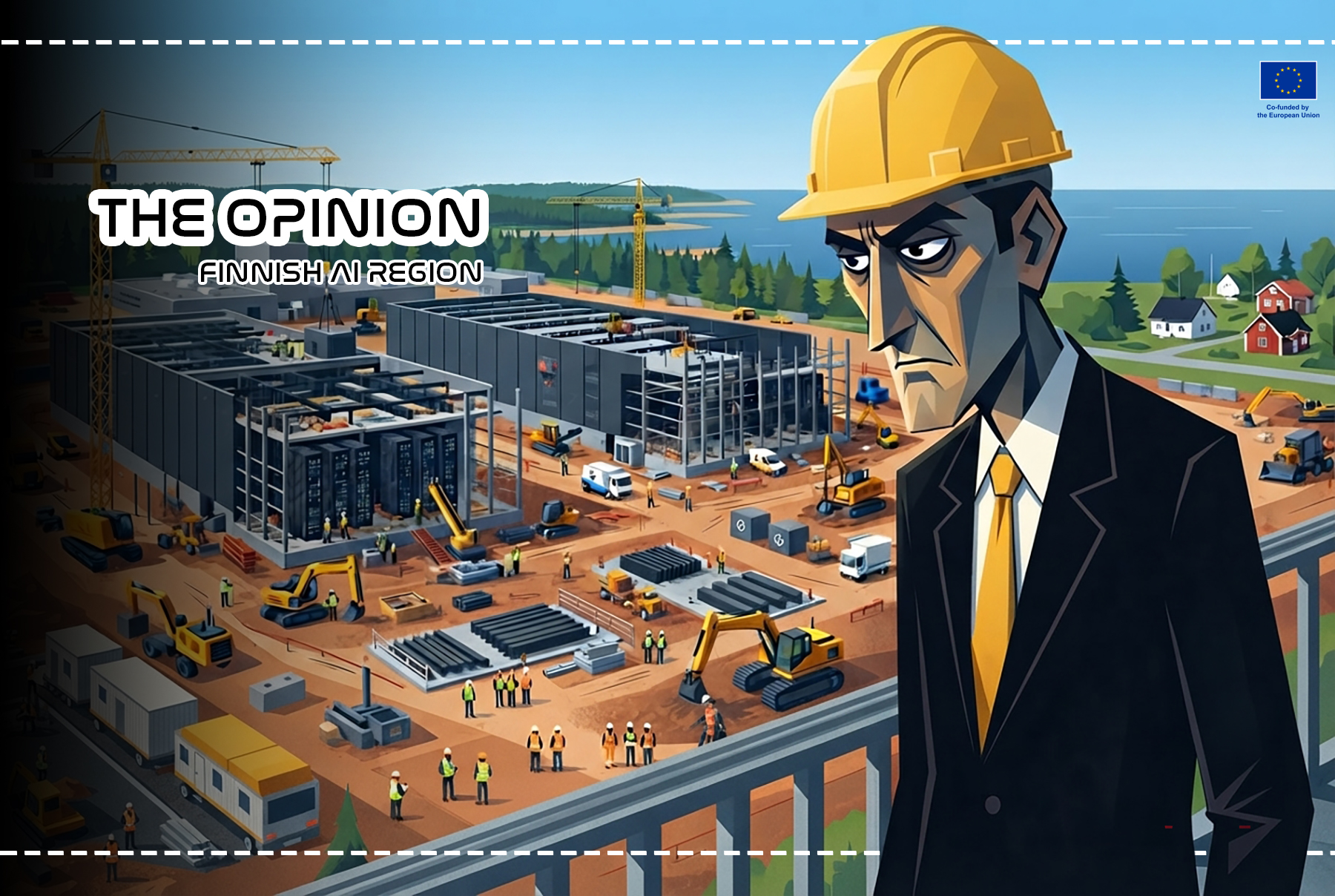
Data centres have become a hot potato in Finland and the United States alike. In the Nordics, people question their usefulness and their impact on the economy (Tolkki 2026), while US President Donald Trump has repeatedly voiced his disappointment that data centres are slipping away to faraway lands (Immonen 2026). The debate has gone into overdrive, especially since tech giant Google announced its decision to invest more than €13 billion in Finnish data centre projects (Koley 2026).
The debate is riddled with misconceptions. Many people don’t really know what data centres are or what they do. To hear people talk, data centres are giant grey boxes stuffed with cat pictures and AI-generated adult content, like some glorified old hard drive. In reality, they are first and foremost computing power. And computing power is the raw material of the 2020s, just as steel, electricity and oil were in their day – and still are.
The European Union (EU) has announced its aim to triple its data centre capacity over the next five to seven years, so that it can meet growing demand for computing and reduce its dependence on technology from outside the EU (European Commission 2025; 2026). In other words, the question is no longer whether data centres will be built in Europe, but where.
A factory that runs on electricity
Put simply, a data centre is a factory whose raw material is electricity and whose product is computation. Inside are thousands of servers and, increasingly, graphics processors (GPUs), working through all manner of calculations round the clock. To run reliably, a data centre needs, above all, a great deal of electricity – and a dependable supply of it. According to the International Energy Agency (IEA), a typical AI data centre consumes as much electricity as 100,000 households, and it cannot stop even for a moment (IEA 2025). The largest ones now under construction consume up to twenty times as much.
Since all electricity ultimately turns into heat, and computation stores no energy, a data centre also needs efficient cooling. Typically, heat is collected from the servers in a closed loop, in which water or a water–glycol mixture flows through pipework either directly through the servers or via air-conditioning units. The heat still has to be got out of the building, however, and this is often done by free cooling, which makes use of cool outdoor air and natural water sources. Google’s data centre in Hamina, for example, is cooled with seawater from the Gulf of Finland (Tropin 2018).
Warmer countries rely heavily on evaporative cooling, in which some of the water evaporates into the atmosphere through cooling towers. It is effective but thirsty, using a great deal of water. With the rise of AI, direct liquid cooling and immersion cooling are also becoming more common, because the most powerful servers generate so much heat that air alone can no longer carry it away. At its best, though, the heat isn’t simply thrown to the wind but fed into the district heating network to warm people’s homes (Wahlroos et al. 2017).
On top of that, a data centre needs fast fibre connections and submarine cables linking it to the rest of the world, as well as a stable operating environment with predictable legislation and a skilled workforce. Finland holds all these cards. A cool climate, a stable grid, good connections and a trustworthy society make us one of the most attractive locations in Europe for data centres, as the growing number of projects shows (Kokko 2026).
The invisible engine of everyday life
Cat pictures are a tiny fraction of what goes on in data centres. Almost every aspect of our daily lives passes through a data centre somewhere, though we barely give it a second thought. Every card payment and bank transfer is processed on servers, as are patient records, X-rays and tax returns. When you book a doctor’s appointment, check the bus timetable or pick up a prescription at the chemist’s, there’s a data centre humming away somewhere in the background.
Industry uses them to control production, simulate products and plan logistics. Sensors on paper machines, in steelworks and on harbour cranes produce a constant stream of data, which is used to adjust processes in near real time. New products, too, are increasingly designed and tested virtually first, saving enormous amounts of time and material. Without computing power, Finland’s export industries simply couldn’t keep pace with international competition.
For science, computing power is the lifeblood. The LUMI supercomputer in Kajaani runs climate models, pharmaceutical research and materials science for the whole of Europe. It is used to forecast extreme weather, model protein structures for new medicines and search for materials for the batteries of the future. Calculations that would take years on an ordinary computer are completed there in a fraction of the time.
The biggest growth, however, will come from AI. Training a language model requires thousands of GPUs computing non-stop for weeks or even months. Yet training is only the beginning, because every question put to an AI also requires computation. As AI becomes part of everyday life in customer service, software development, healthcare and public administration, the demand for computing power will multiply many times over.
In other words, when a data centre goes down, it takes a lot more than Netflix with it. Bill payments, shop tills and hospital systems all grind to a halt. That’s why data centres are classed as critical infrastructure (EU 2022/2557; EU 2022/2555). They are the modern equivalent of waterworks and power stations: nobody notices them as long as everything runs according to plan.
From concrete box to ecosystem
Once built, a data centre doesn’t employ very many people. The value lies in what grows up around it. In Finland’s case, the development can be expected to come in waves. First come the AI factories and the data centres themselves – and in Finland, this is already well under way. Google has operated in a former paper mill in Hamina for years, Microsoft is building in the Helsinki metropolitan area, and a European AI factory has grown up around the LUMI supercomputer in Kajaani (CSC 2026). The construction phase employs thousands of people, directly and indirectly, and contracts for electrical work, fibre and cooling are spread far and wide.
After the construction phase, an ecosystem takes shape. When computing power is close at hand, it draws in data brokers, software houses, AI start-ups and cybersecurity firms, along with maintenance and support services. In many applications latency is decisive, so developers may well want premises near the centres. In this way, a data centre can become a locomotive pulling new expertise and jobs along behind it.
In the third phase, critical functions move closer to the computing. As companies and organisations seek to keep running come what may, they set up remote offices and backup centres in places such as Kajaani, Lappeenranta and Hamina. This brings highly skilled jobs beyond the capital region, too. At the same time, towns outside the growth centres gain new taxpayers, fresh life for their services and a reason for young people to stay in, or return to, their home towns (e.g. Alvarez et al. 2026).
On top of all this, data centres produce heat that can be channelled into district heating networks. Google supplies Hamina with its data centre’s waste heat almost free of charge, and that heat now warms nearly the whole town (Schönberg 2025). The LUMI supercomputer in Kajaani and Nebius’s data centre in Mäntsälä are likewise already heating thousands of local homes and have helped bring down district heating bills for customers (CSC 2026; Jetzinger 2025; Huuhtanen 2025). In the Helsinki metropolitan area, heat from Microsoft’s centres is set to warm tens of thousands of homes (Microsoft 2022). In a cold country like Finland, that is a competitive advantage.
AI can't wait for the wind to blow
Any discussion of data centres must, however, get to the heart of the matter: electricity. Data centres need a steady supply every hour of every day. Many regard wind power as a Finnish success story, and it does indeed produce cheap, green electricity, but where data centres are concerned the sticking point is winter. The trends show that wind output drops precisely when consumption peaks (Horppu 2026; Rouhiainen 2024).
Data centres can’t sit and wait for the wind to pick up at the end of a cold snap. If hundreds of megawatts’ worth of data centres are connected to the same grid at once, a great deal of balancing power is needed – and it cannot be at the mercy of the weather (Fingrid 2026; Pantzar 2024). Fossil fuels are no longer an option, so Finland needs new nuclear power. Olkiluoto 3 has already shown what a single reactor can do for Finland’s energy self-sufficiency. Now we need a couple more – and the sooner the better.
The government should set the wheels in motion: a fast track for permitting, a clear position on small modular reactors and a stronger transmission grid. Building a nuclear power station takes years, so the decisions must be made now, or our competitive edge will slip through our fingers. The data centre boom is a once-in-a-generation opportunity for Finland, but only if we get it right. It brings investment, jobs in the regions and much-needed warmth to homes in the frozen North.
But none of this will happen of its own accord. It takes electricity – lots of it, and a reliable supply. The ball is now firmly in the decision-makers’ court. Finland needs more nuclear power, a stronger transmission grid and a clear message that we want to be a computing superpower. The cat pictures will no doubt keep on coming, but behind them something far bigger is taking shape. So big, in fact, that it’s hard to get your head around.
Author

References
Alvarez, F. E., Argente, D., Chow, J. & Van Patten, D. (2026). Data Centers and Local Economies in the Age of AI: A Shift–Share Approach. Working Paper 35194. National Bureau of Economic Research.
CSC. (2026, 10 September). LUMI AI Factory advances toward Europe’s first superconducting quantum computer with logical qubits. CSC. Accessed 18 September 2026.
European Commission. (2025). AI Continent Action Plan [Tekoälyn maanosa -toimintasuunnitelma: EU johtoasemaan tekoälyn alalla]. European Commission.
European Commission. (2026, 21 September). Making data centres more energy-efficient with the EU’s new rating scheme [Datakeskuksista energiatehokkaampia EU:n uuden luokitusjärjestelmän avulla]. European Commission. Accessed 23 September 2026.
Fingrid. (2026, 18 August). Electricity consumption is set for strong growth – more balancing power is needed alongside it [Sähkönkulutus on kääntymässä voimakkaaseen kasvuun – rinnalle tarvitaan lisää säätövoimaa]. Fingrid. Accessed 15 September 2026.
Huuhtanen, P. (2025, 14 March). Will Mäntsälä’s data centres also heat neighbouring municipalities? – ‘This is a significant project’ [Lämmittävätkö Mäntsälän datakeskukset jatkossa myös naapurikuntia? – “Kyseessä on merkittävä hanke”]. Keski-Uusimaa. Accessed 18 September 2026.
Immonen, J. (2026, 30 September). Trump mentions Finland again – twice [Trump mainitsi Suomen jälleen – kahdesti]. Ilta-Sanomat. Accessed 30 September 2026.
International Energy Agency (IEA). (2025). Energy and AI: Executive summary. IEA. Accessed 20 September 2026.
Jetzinger, J. (2025, 22 January). One of the world’s most efficient data centres will soon be humming in Mäntsälä [Mäntsälässä hyrrää pian yksi maailman tehokkaimmista datakeskuksista]. Municipality of Mäntsälä. Accessed 18 September 2026.
Kokko, M. (2026, 2 August). Data centres coming to Finland at a record pace: nearly 100 in the pipeline [Suomeen datakeskuksia ennätysvauhtia: Lähes 100 suunnitteilla]. Ilta-Sanomat. Accessed 24 September 2026.
Koley, B. (2026, 9 September). Google deepens its commitment to Finland with a €13 billion investment in AI infrastructure. Google. Alphabet.
Microsoft. (2022, 17 March). Microsoft and Fortum join forces – Microsoft to build a data centre region in Finland producing emission-free district heat for Fortum’s customers in the capital region [Microsoft ja Fortum yhteistyöhön – Microsoft rakentaa Suomeen datakeskusalueen, joka tuottaa päästötöntä kaukolämpöä Fortumin asiakkaille pääkaupunkiseudulla]. Microsoft News Center.
Pantzar, M. (2024, 26 March). An unusual record: Finland’s wind turbines are consuming electricity and producing nothing [Erikoinen ennätys: Suomen tuulivoimalat kuluttavat sähköä eivätkä tuota mitään]. Yle News. Accessed 17 September 2026.
Rouhiainen, V. (2024, 2 September). Households’ direct electricity consumption is falling – microdata deepen our understanding of home heating methods [Kotitalouksien suora sähkön kulutus on laskussa – mikroaineistot syventävät tietoja asumisen lämmitystavoista]. Statistics Finland. Accessed 18 September 2026.
Schönberg, K. (2025, 19 August). Waste heat from Google’s data centre will soon heat almost the whole of Hamina [Googlen datakeskuksen hukkalämpö lämmittää kohta lähes koko Haminan kaupungin]. Yle News. Accessed 18 September 2026.
Tolkki, K. (2026, 16 September). Finns are waking up to oppose data centres, while in the US nobody wants them in their back yard [Suomalaiset heräilevät vastustamaan datakeskuksia, Yhdysvalloissa niitä ei haluta omalle takapihalle]. Yle News. Accessed 20 September 2026.
Tropin, K. (2018, 18 June). GCP arrives in the Nordics with a new region in Finland. Google Cloud. Google.
Wahlroos, M., Pärssinen, M., Manner, J. & Syri, S. (2017). Utilizing data center waste heat in district heating – Impacts on energy efficiency and prospects for low-temperature district heating networks. Energy, 140, 1228–1238.